
The Story of a Forest, a People focuses on Akbelen Forest, the villagers living around it, and their resistance since 2019 against the expansion of a coal mining site. With 69% of Muğla’s forests under threat and the region increasingly affected by drought, local inhabitants have been compelled to take political action to defend their land and way of life.
The resistance is led predominantly by women of all ages, who confront tear gas and pressurized water from the gendarmerie while expressing their dismay at the violence they face. Their struggle echoes broader movements in which women take leading roles in defending ecological sites from exploitation. Through the interviews I am conducting with the villagers, it becomes clear that although women are at the forefront, the support of the entire community is essential to the strength and continuity of the movement.
In Akbelen, land grabs, the privatization of forest areas, and attempts to remove the protected status of olive trees are justified in the name of “public interest.” Yet these policies prioritize private profit while producing long-term ecological damage, public health risks, and the erosion of local livelihoods. Akbelen is one of many sites where communities resist such destruction, insisting on a different understanding of what constitutes public interest.
Through field research, photography, interviews, and the use of local materials in alternative photographic processes, the project explores the relationship between the forest and the people who have lived with it for generations. I translate the emotional landscape of this struggle through portraits and materials from the villagers’ personal archives. Using charcoal collected from forest fires in the same region to create watercolors on cyanotypes, I work with traces of loss, resilience, and continuity.
The project seeks to hold space for these experiences and to reflect on what can be learned from those who continue to defend the forest. It also considers how the bonds formed through shared loss can resonate beyond Akbelen, offering ways of understanding survival in the present.
The resistance is led predominantly by women of all ages, who confront tear gas and pressurized water from the gendarmerie while expressing their dismay at the violence they face. Their struggle echoes broader movements in which women take leading roles in defending ecological sites from exploitation. Through the interviews I am conducting with the villagers, it becomes clear that although women are at the forefront, the support of the entire community is essential to the strength and continuity of the movement.
In Akbelen, land grabs, the privatization of forest areas, and attempts to remove the protected status of olive trees are justified in the name of “public interest.” Yet these policies prioritize private profit while producing long-term ecological damage, public health risks, and the erosion of local livelihoods. Akbelen is one of many sites where communities resist such destruction, insisting on a different understanding of what constitutes public interest.
Through field research, photography, interviews, and the use of local materials in alternative photographic processes, the project explores the relationship between the forest and the people who have lived with it for generations. I translate the emotional landscape of this struggle through portraits and materials from the villagers’ personal archives. Using charcoal collected from forest fires in the same region to create watercolors on cyanotypes, I work with traces of loss, resilience, and continuity.
The project seeks to hold space for these experiences and to reflect on what can be learned from those who continue to defend the forest. It also considers how the bonds formed through shared loss can resonate beyond Akbelen, offering ways of understanding survival in the present.
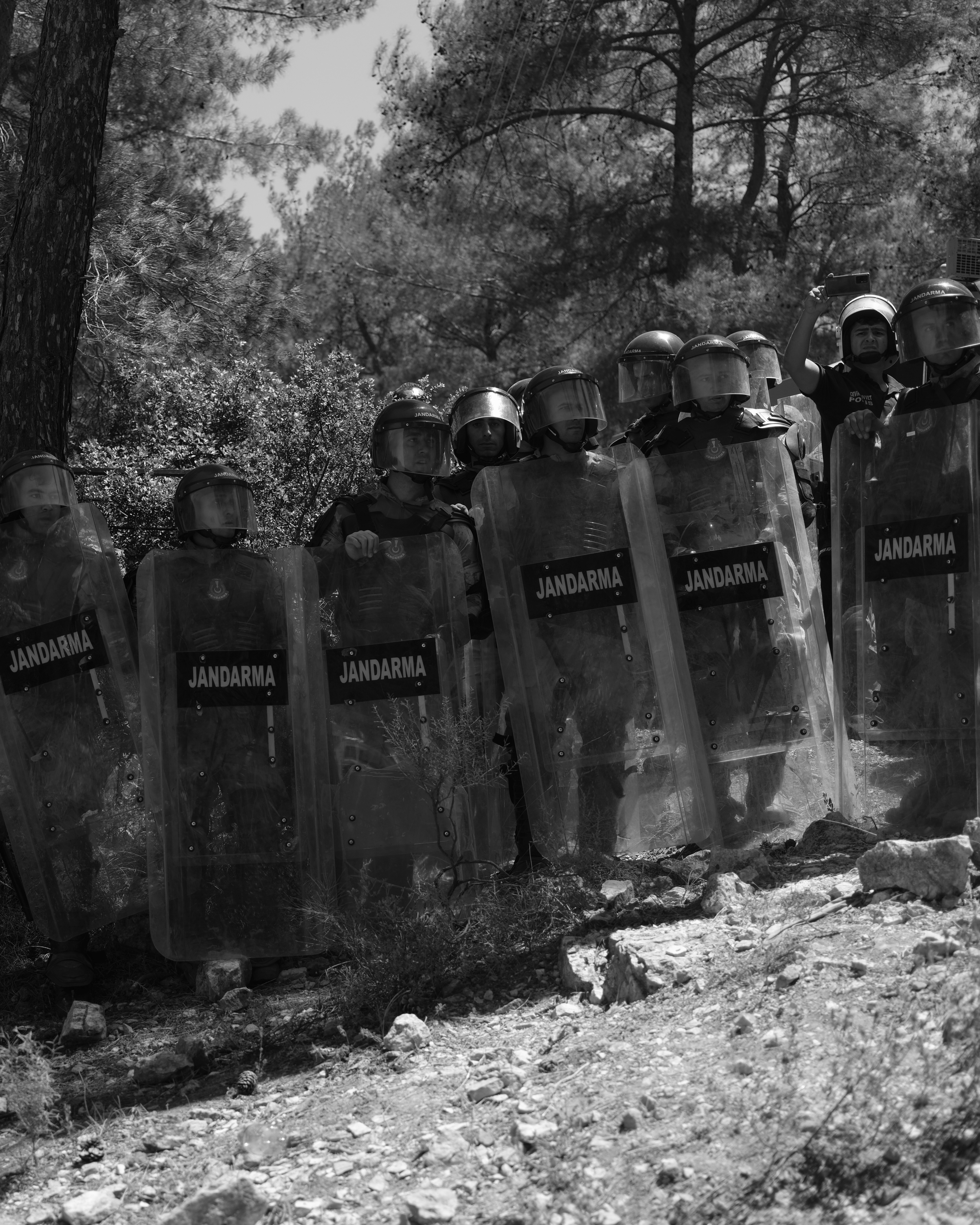


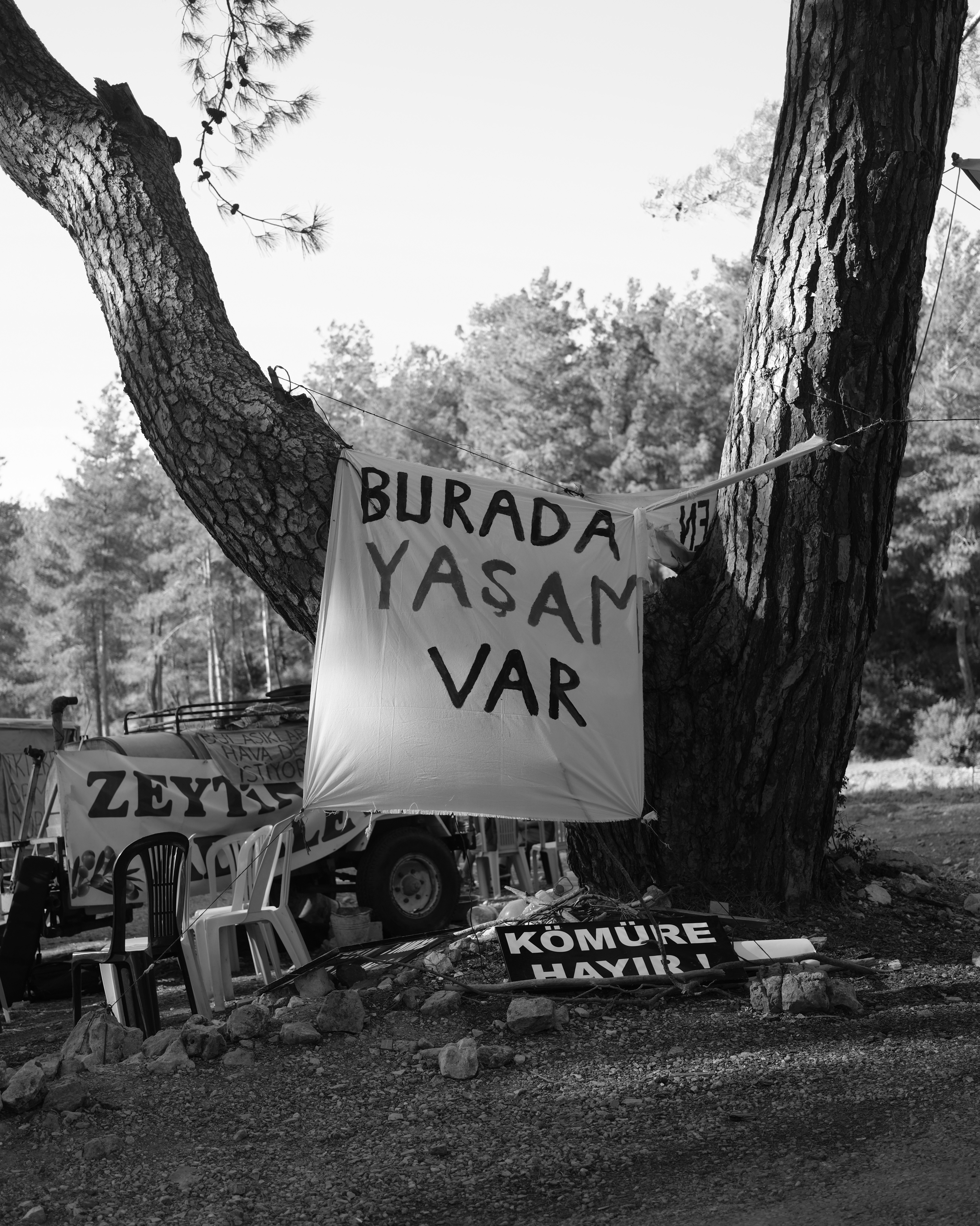


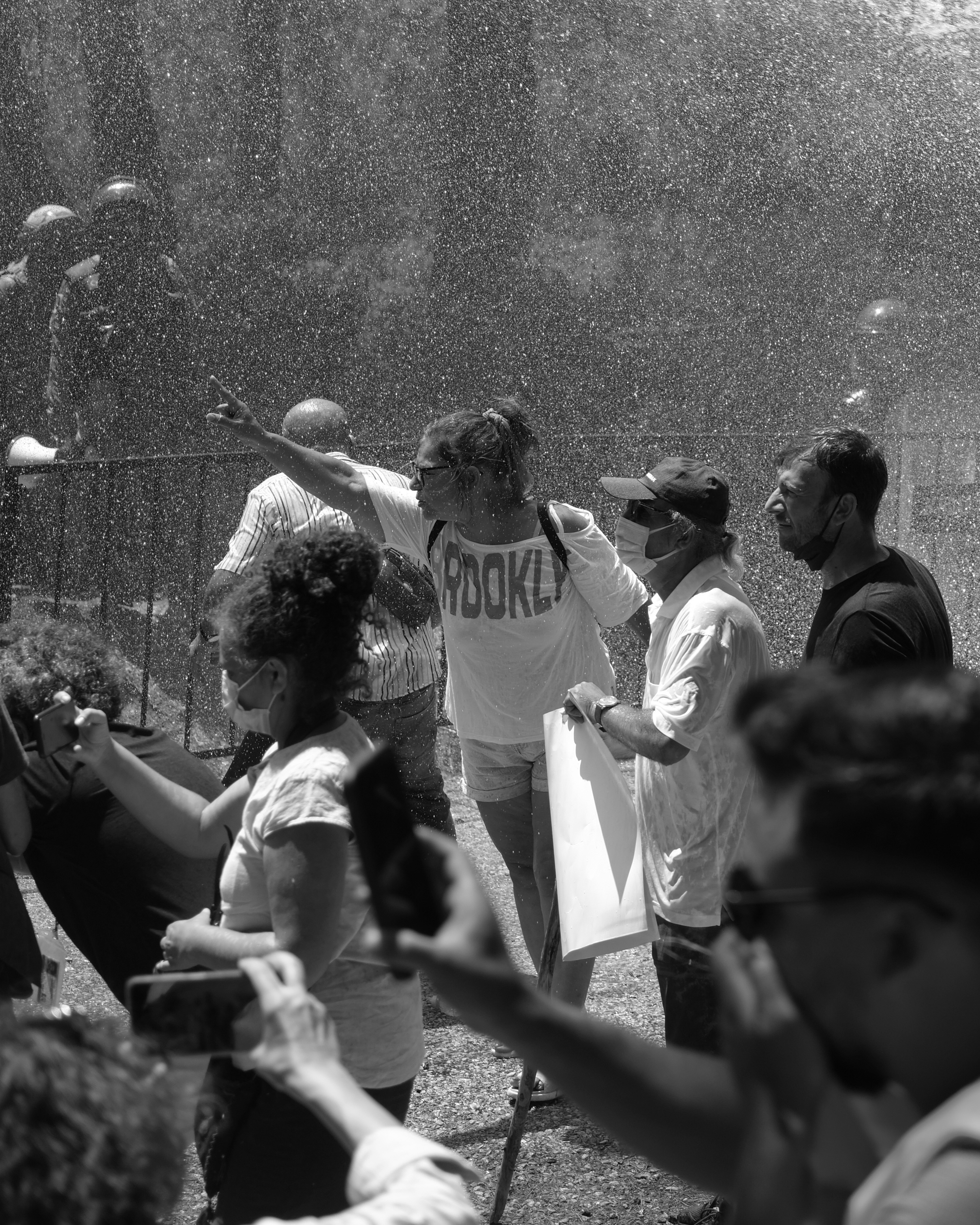
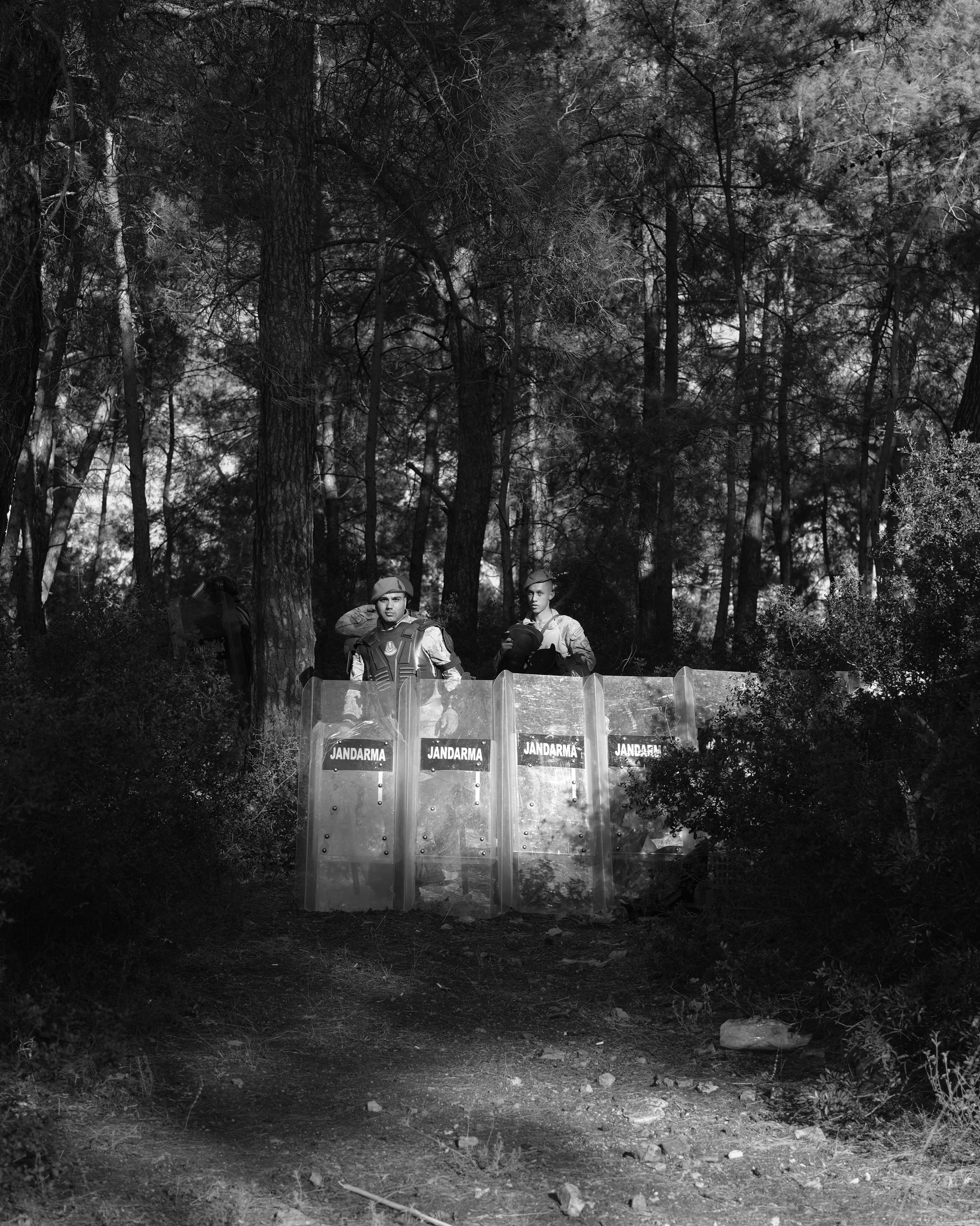
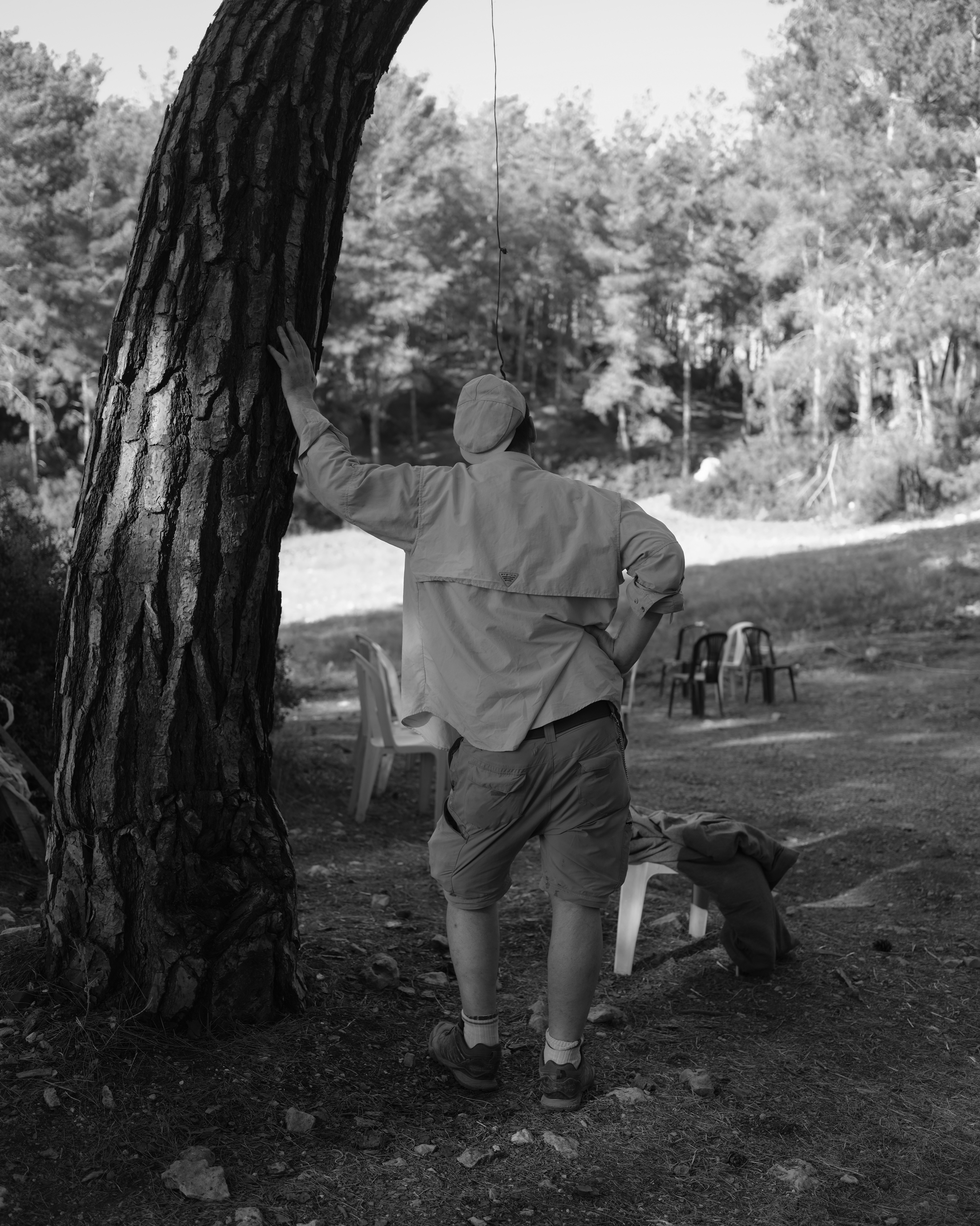


Akbelen Forest protests, July 2023.

Akbelen #01, Charcoal watercolor on cyanotype print, 80x100 cm, 2025.

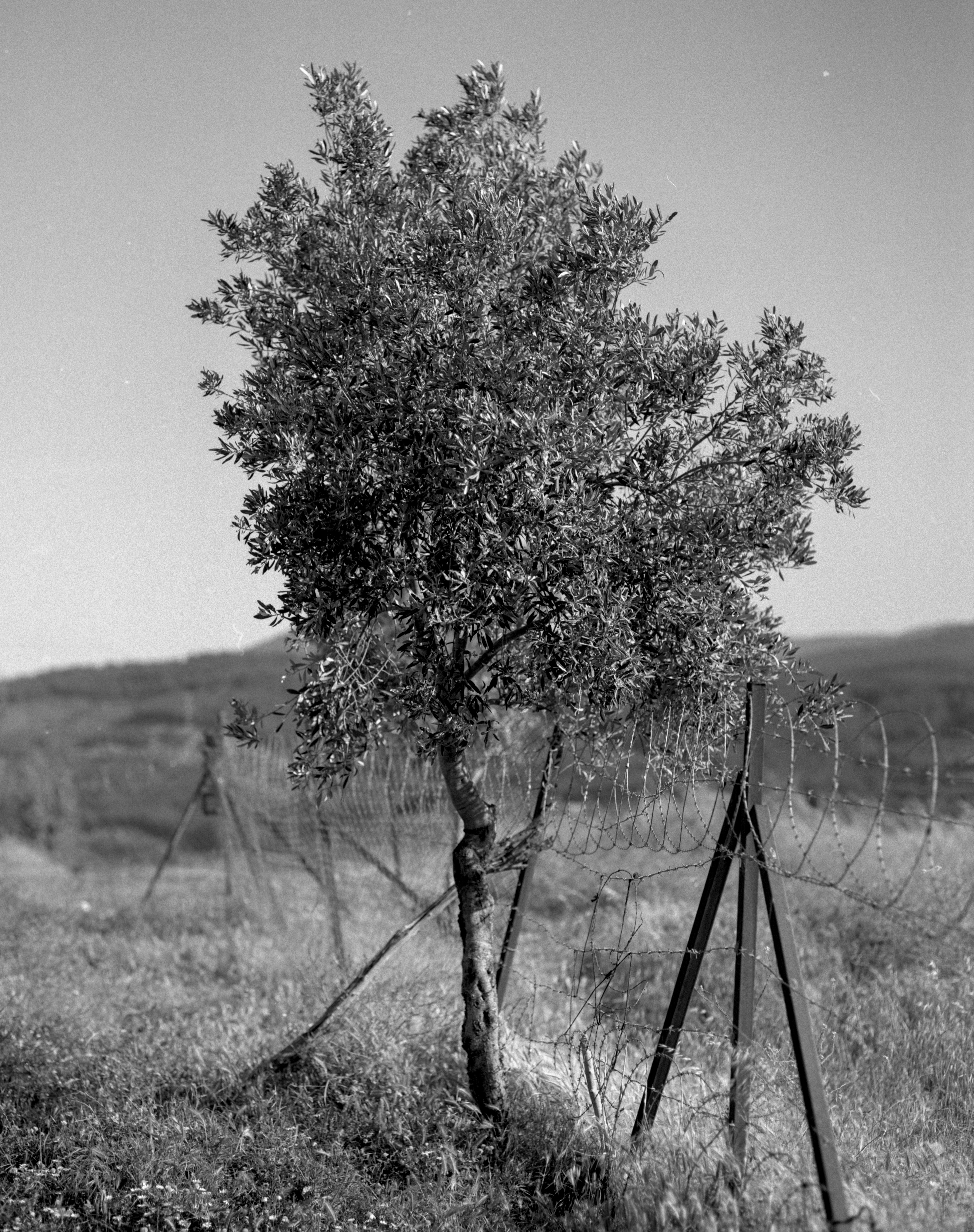
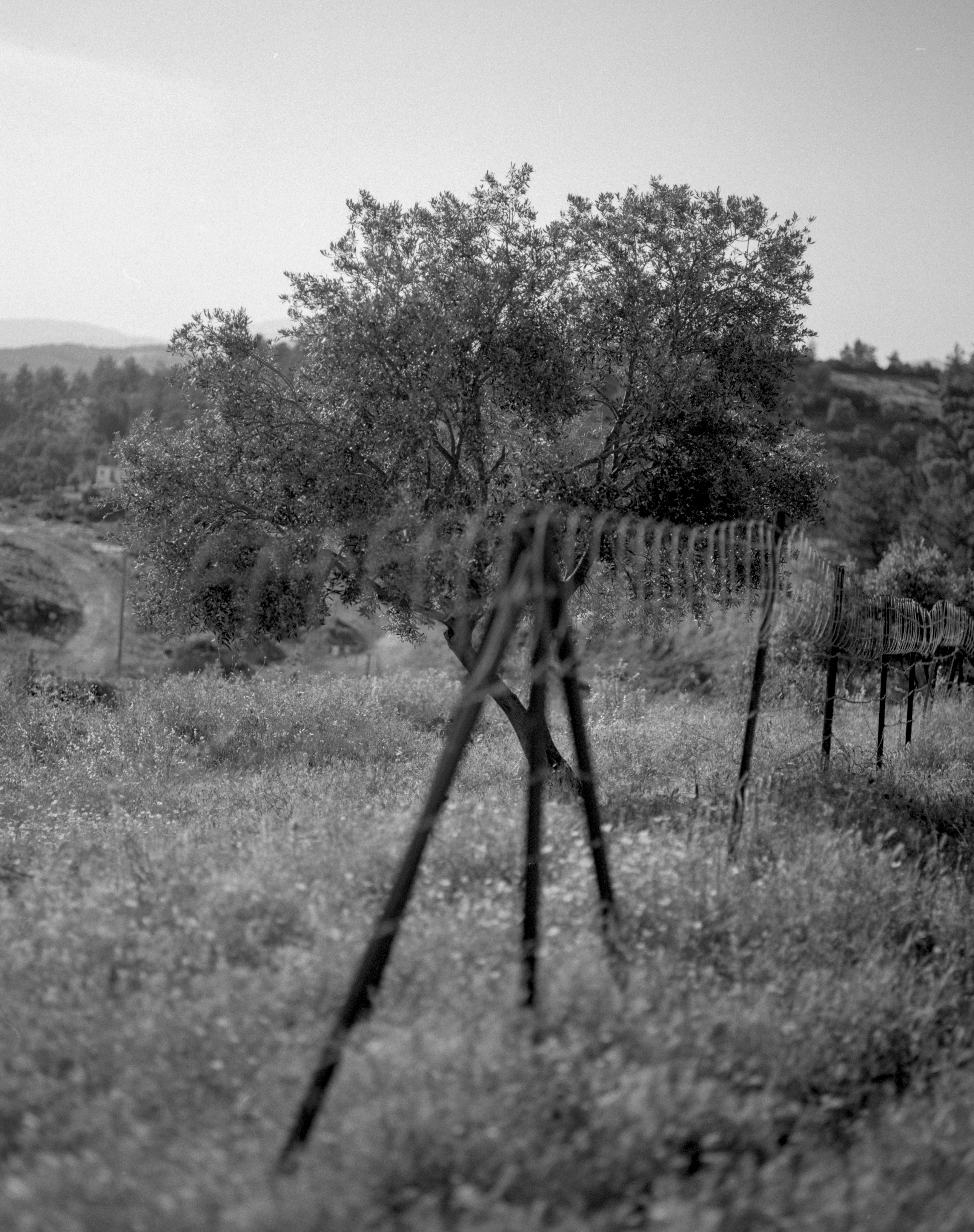
Coal mine on the edge of Akbelen Forest, 2025.

Akbelen #01, Charcoal watercolor on cyanotype print, 80x100 cm, 2025.

Akbelen Forest’s remains within the new territory of the coal mine, 2024.
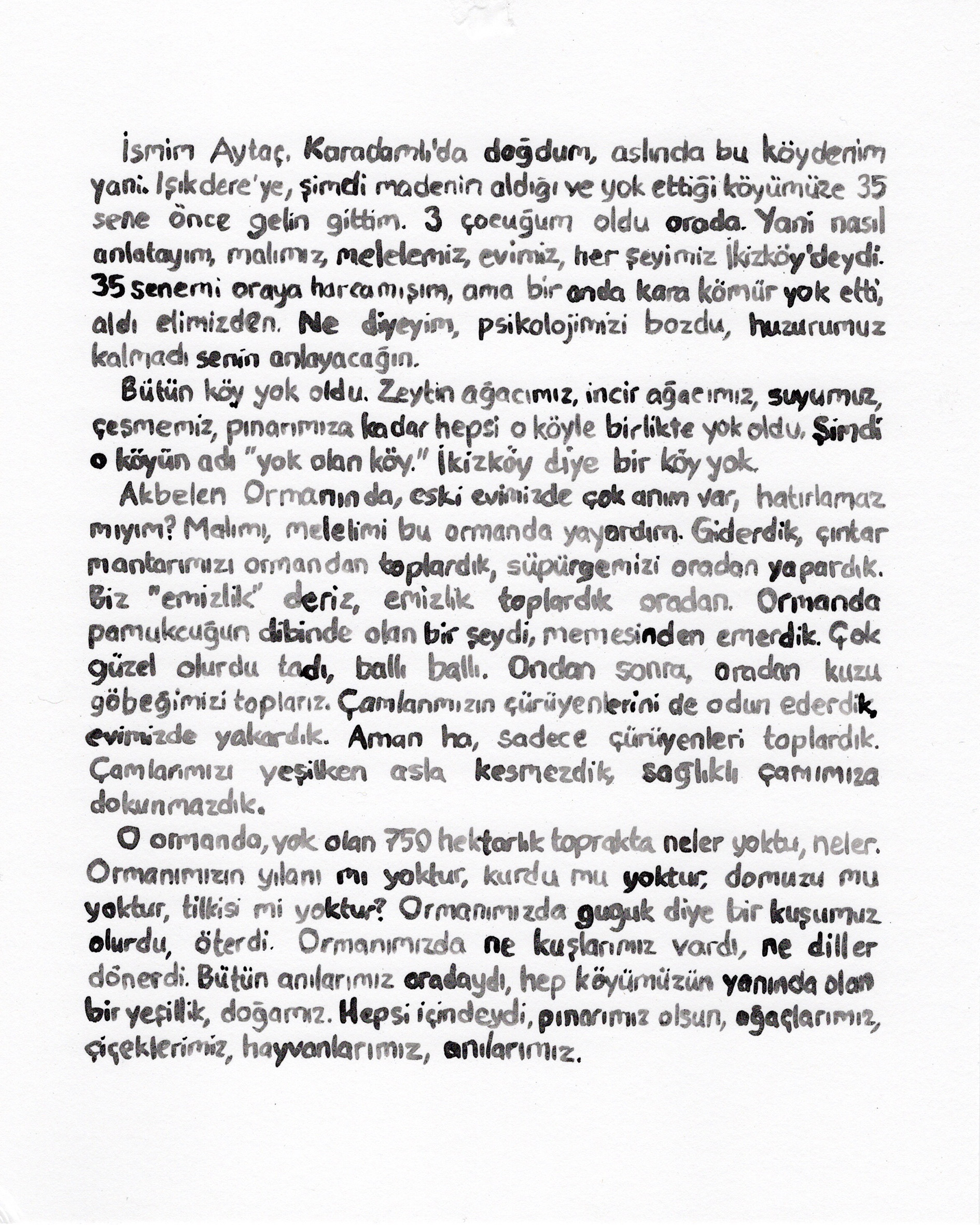


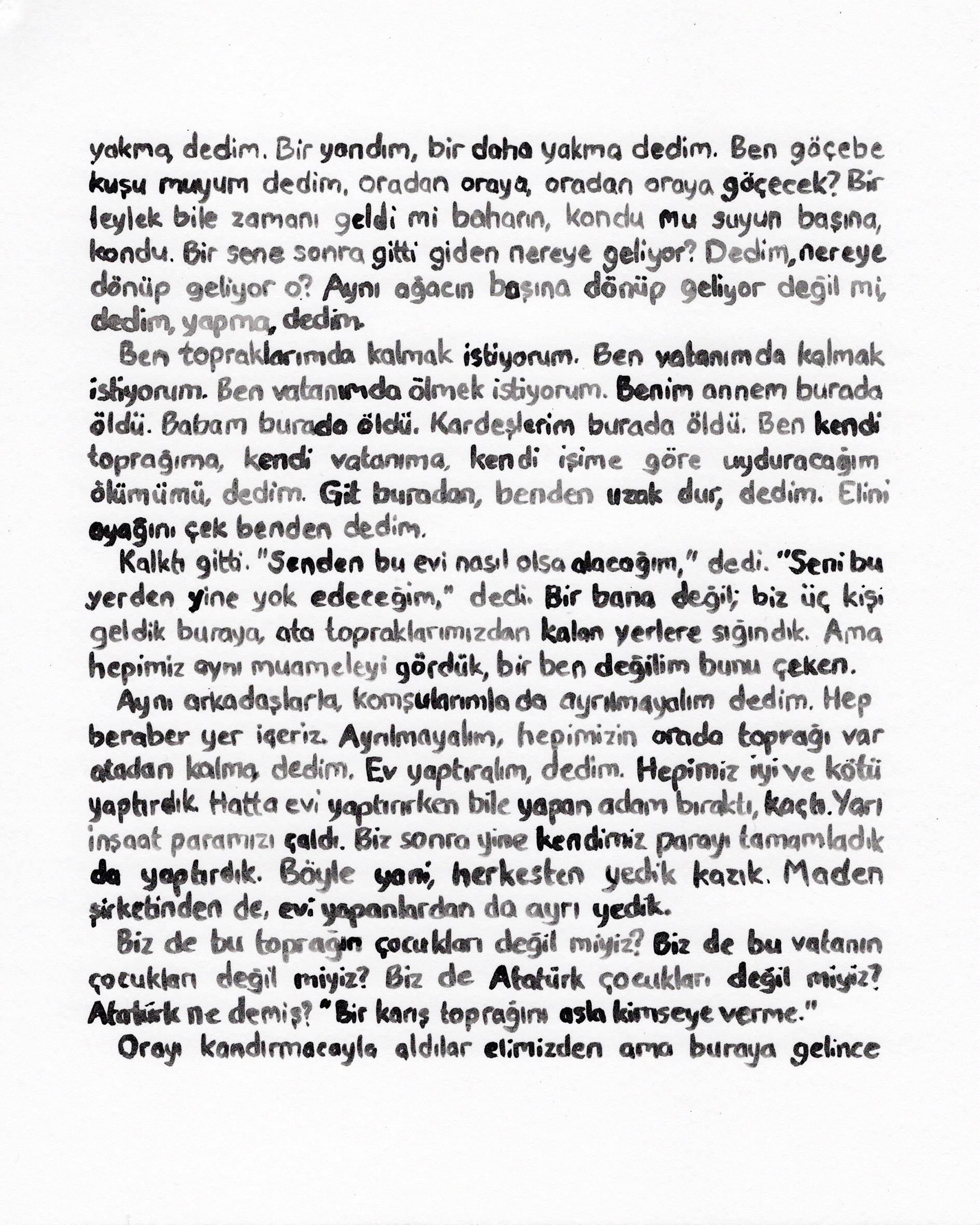


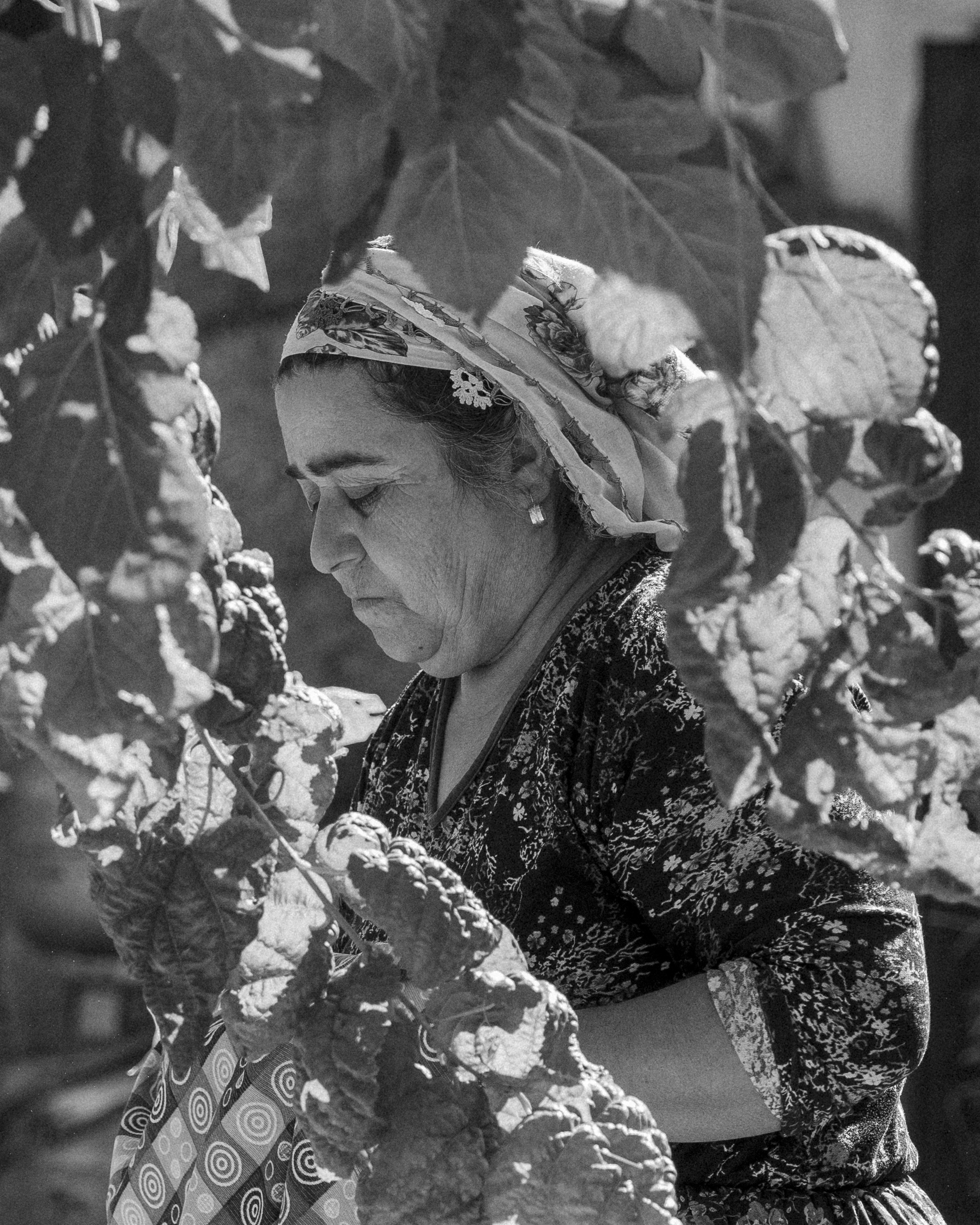

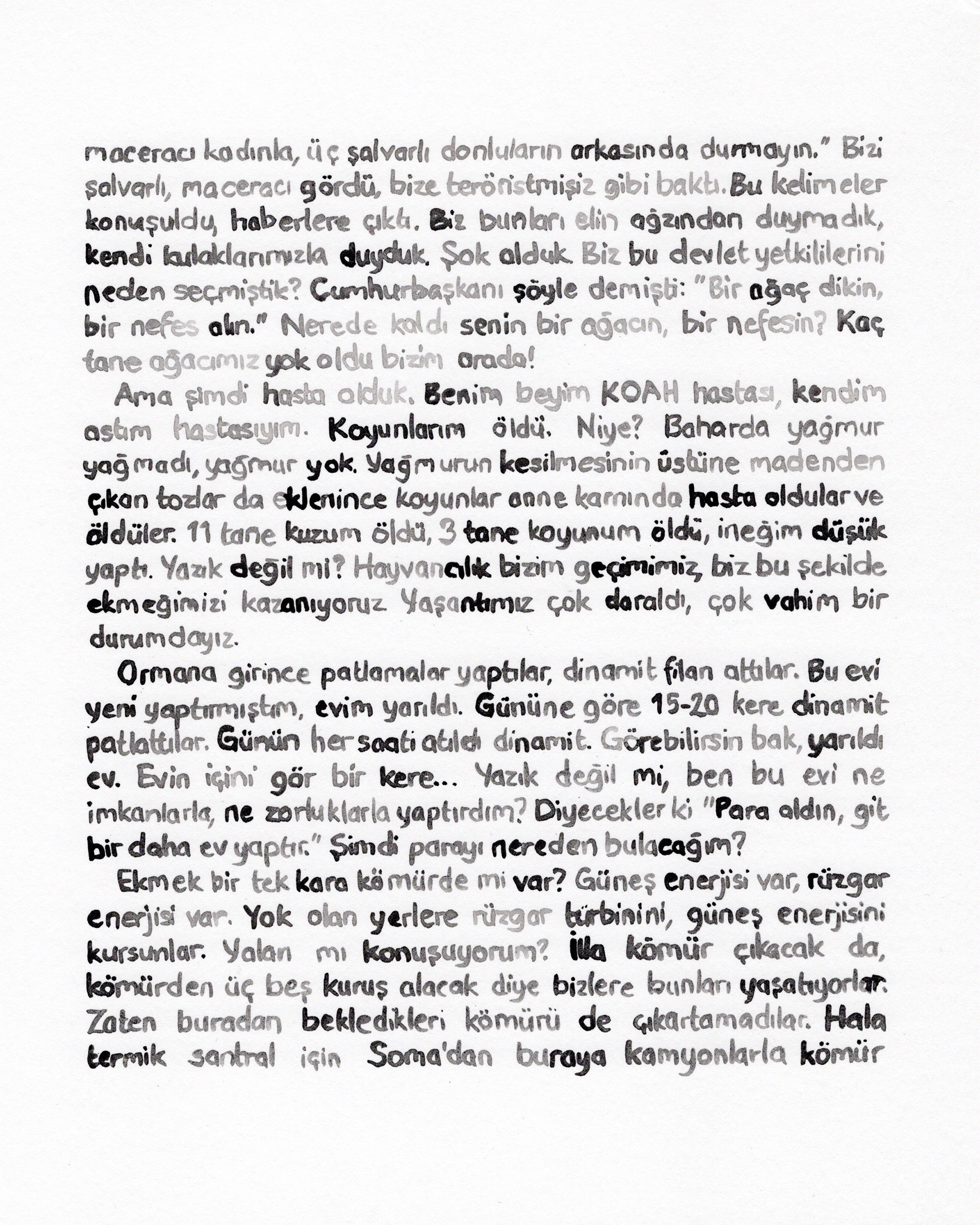


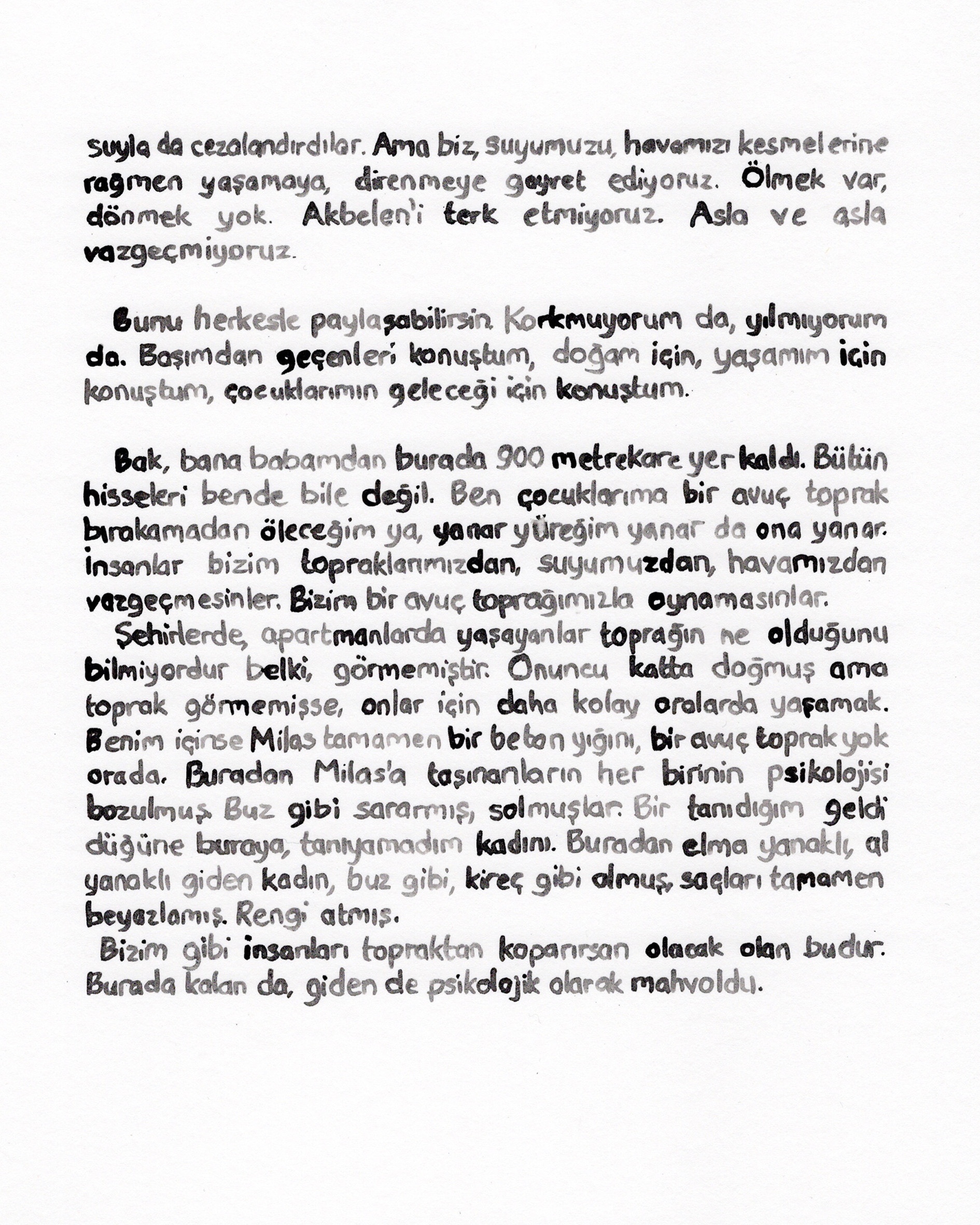
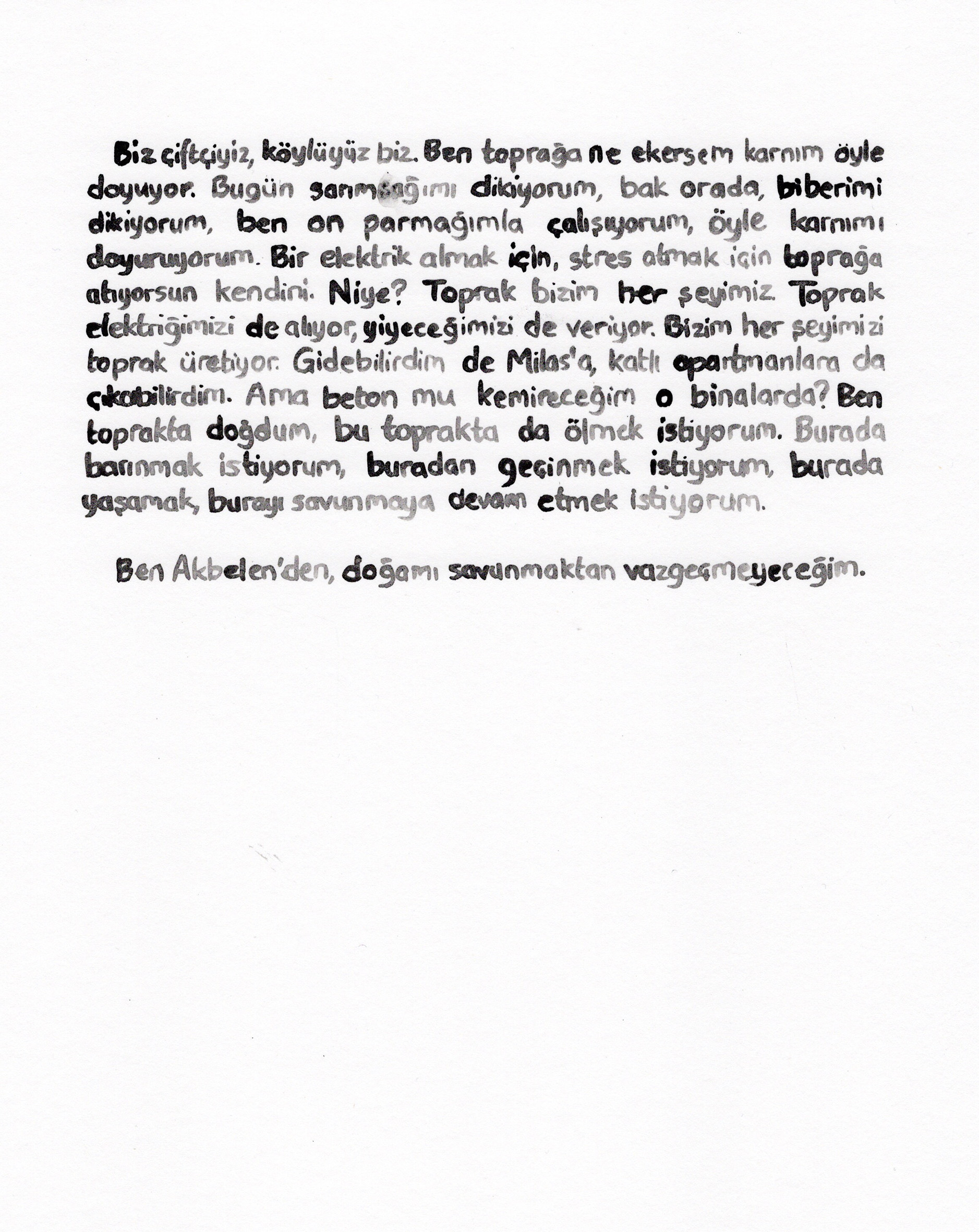
Watercolor of the transcription of our interview with Aytaç, a longtime resident of İkizköy, where she lived for 35 years before the land was sold to the coal mine under false pretenses.
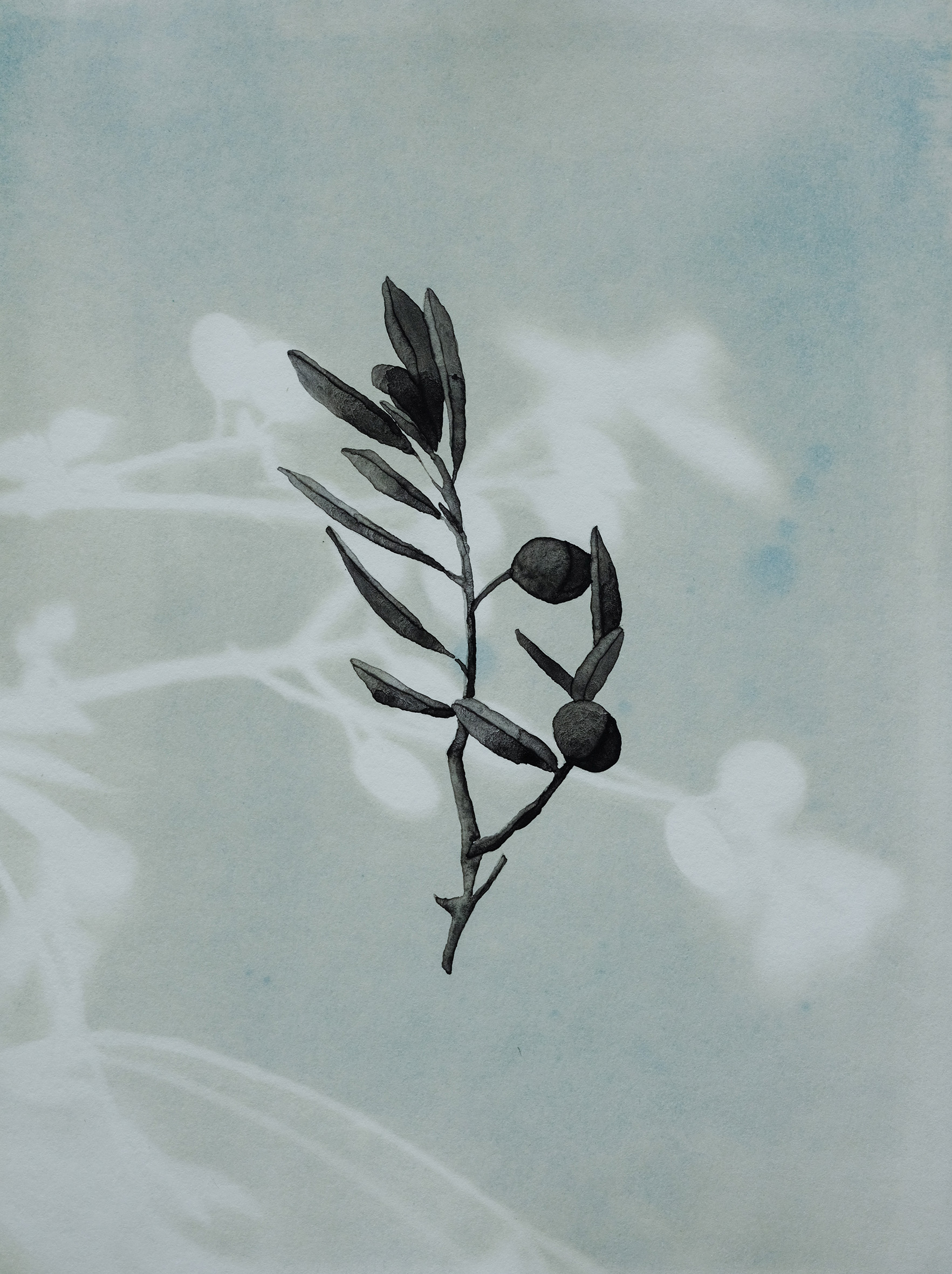
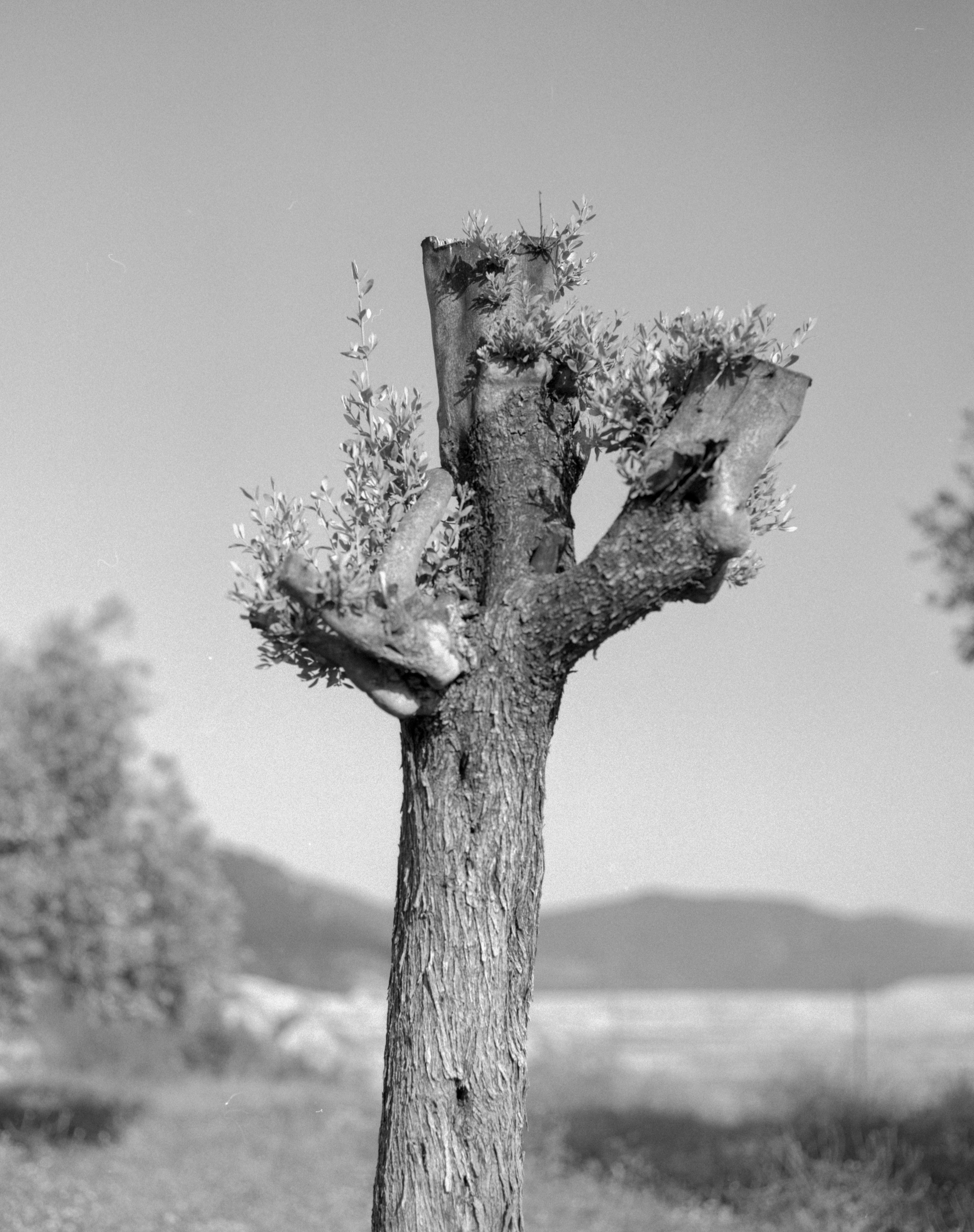
Charcoal and watercolor drawing on a cyanotype print of olive trees in Muğla, 2025.

Muzaffer and his wife, in their garden next to Akbelen Forest, 2024.

Muzaffer’s garden, 2024.
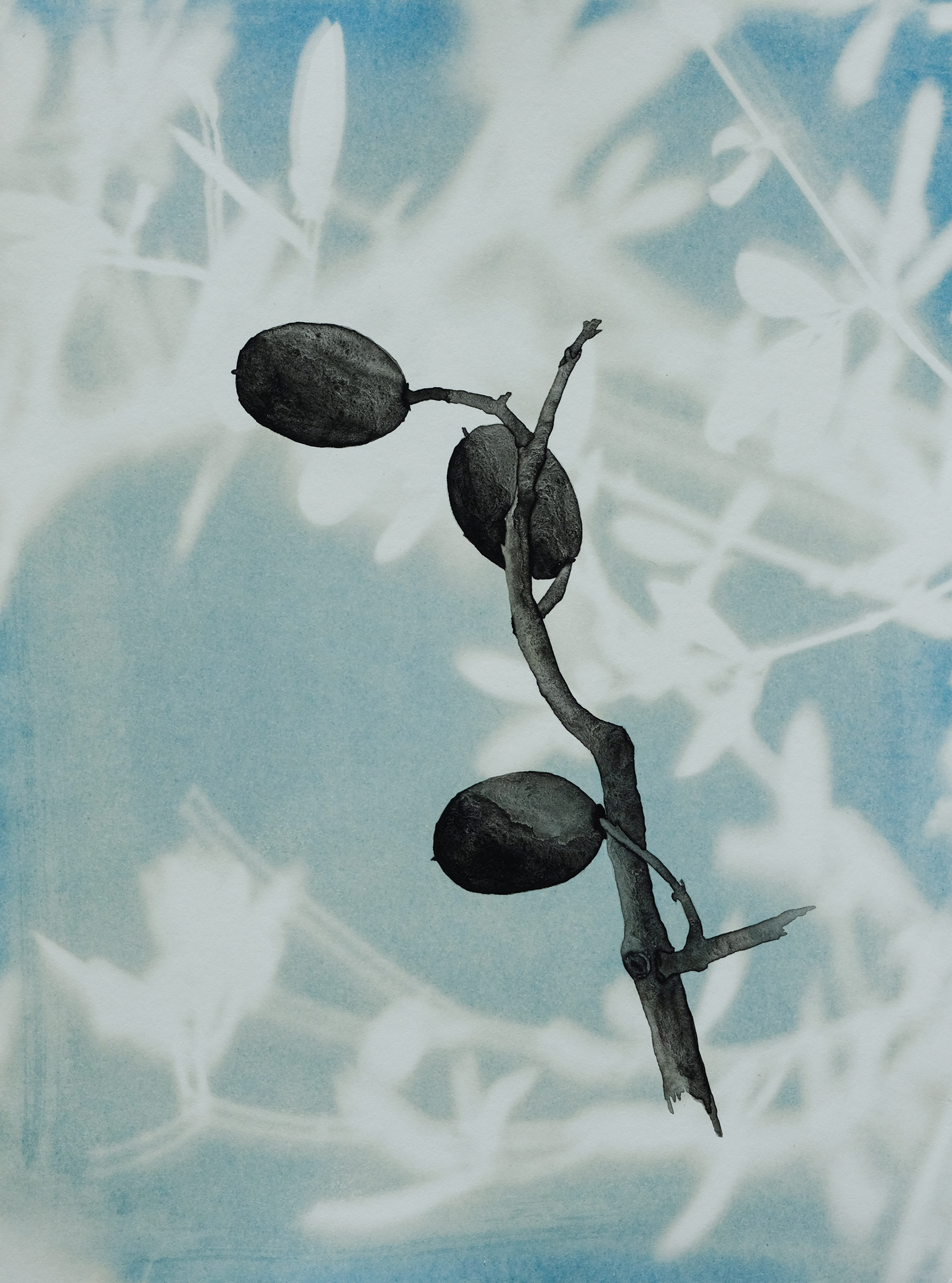
Charcoal and watercolor drawing on a cyanotype print of olive trees in Muğla, 2025.
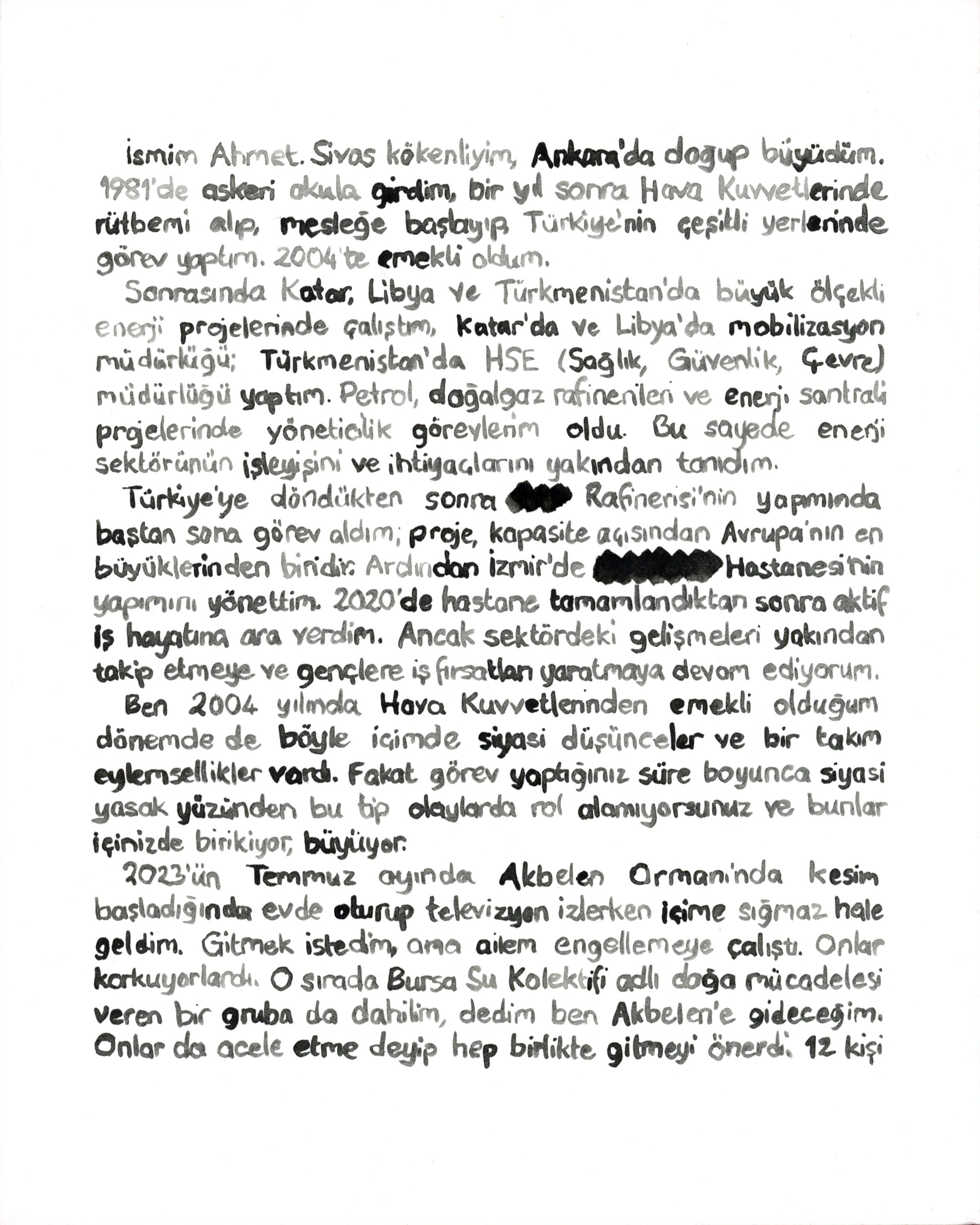
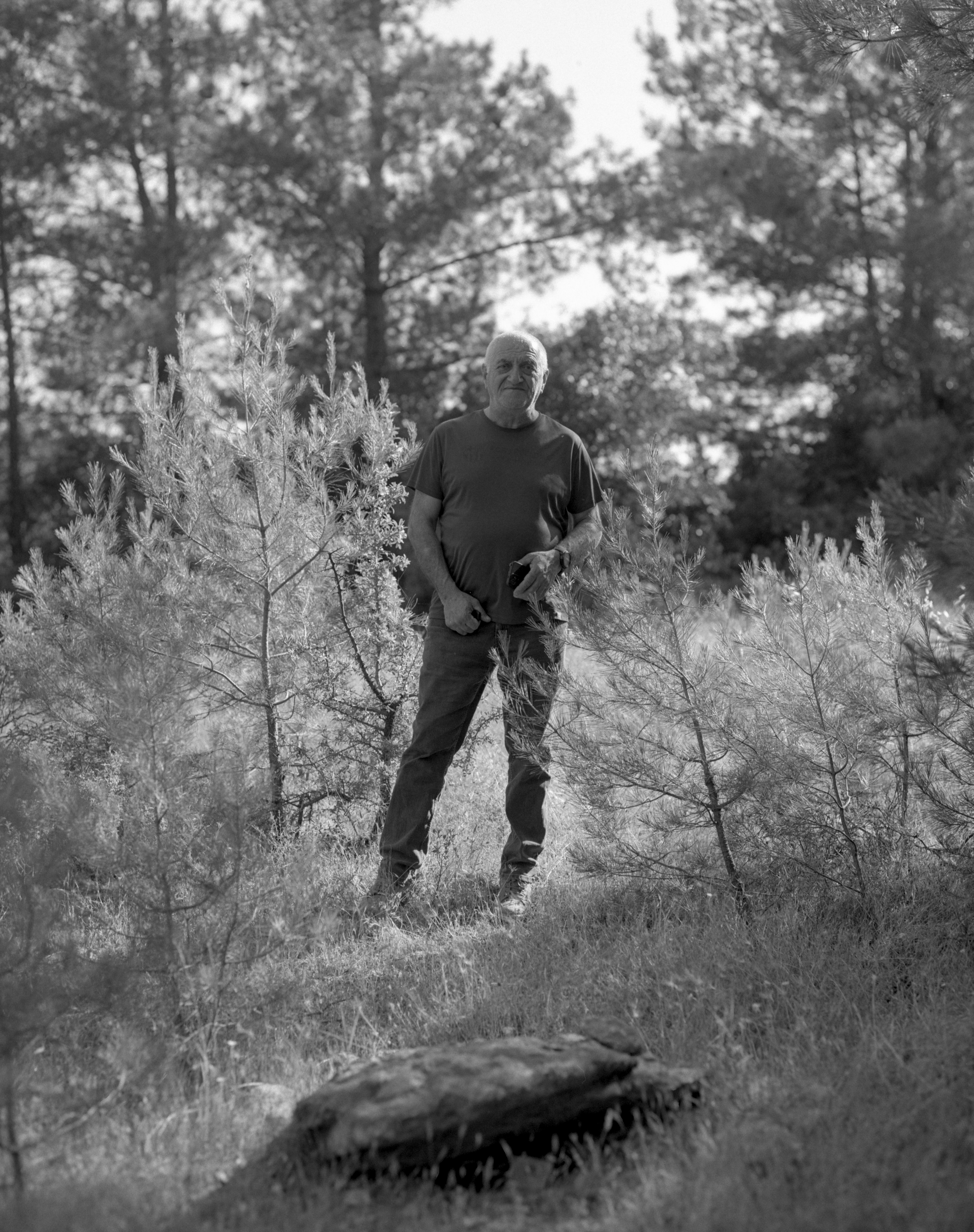
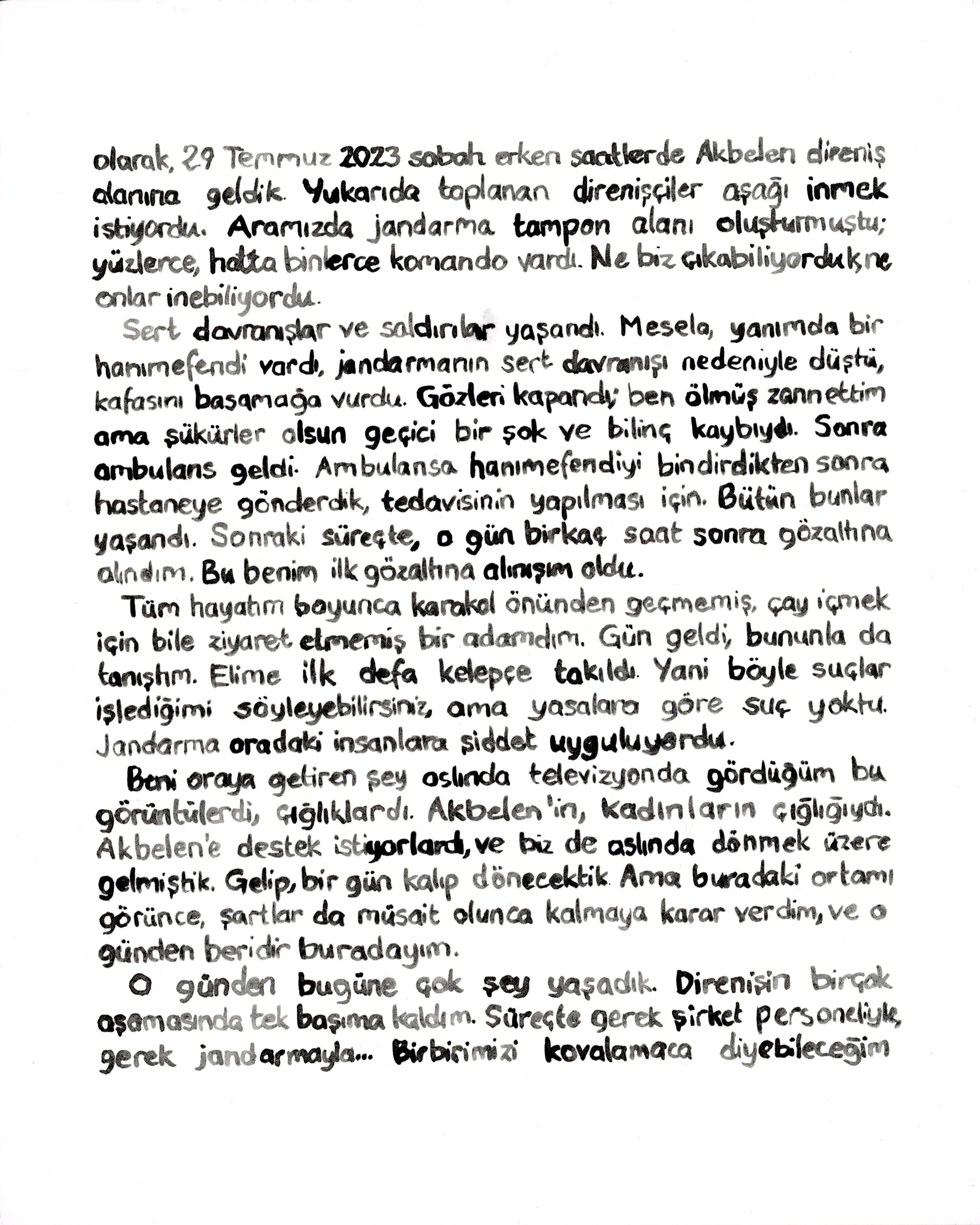
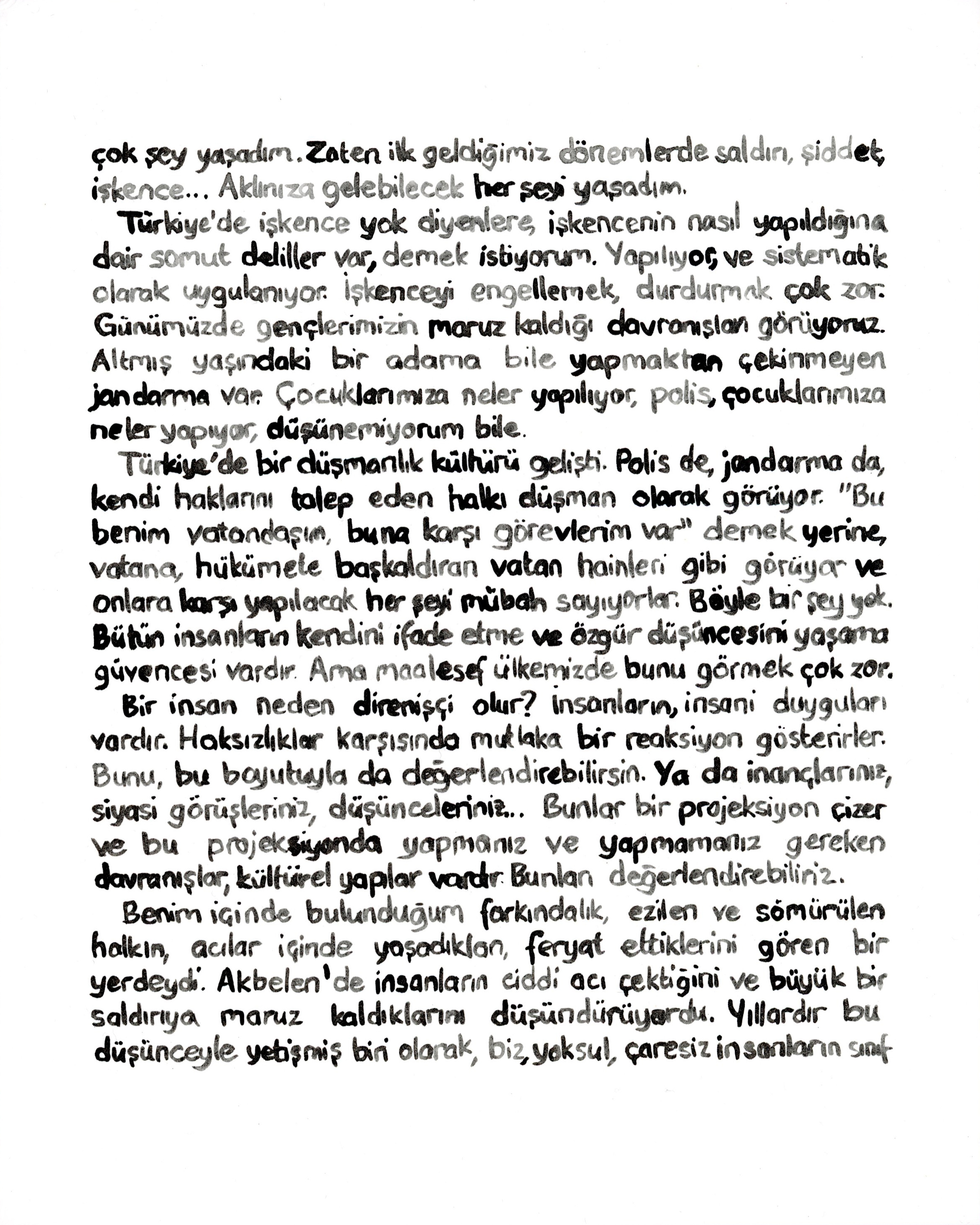
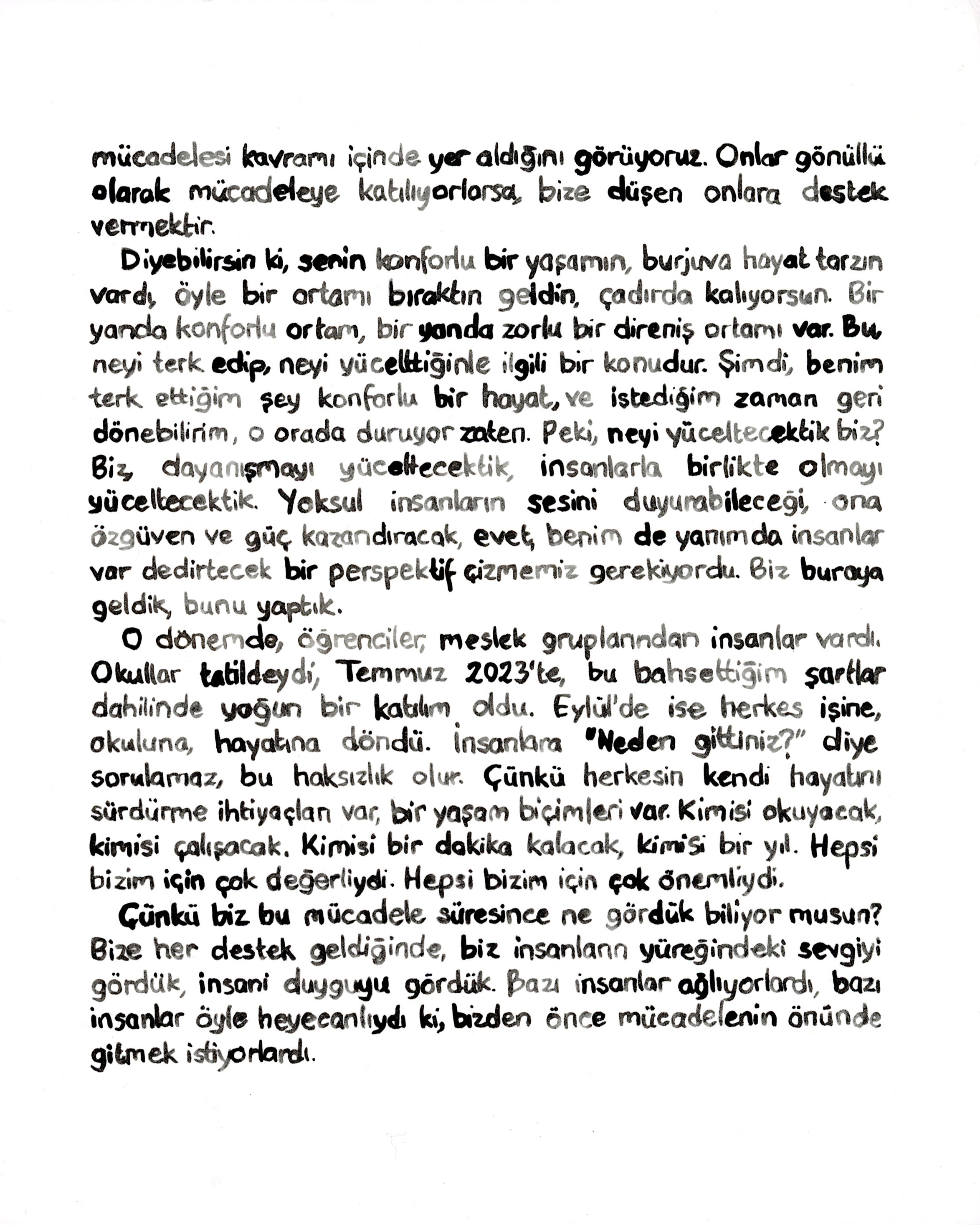
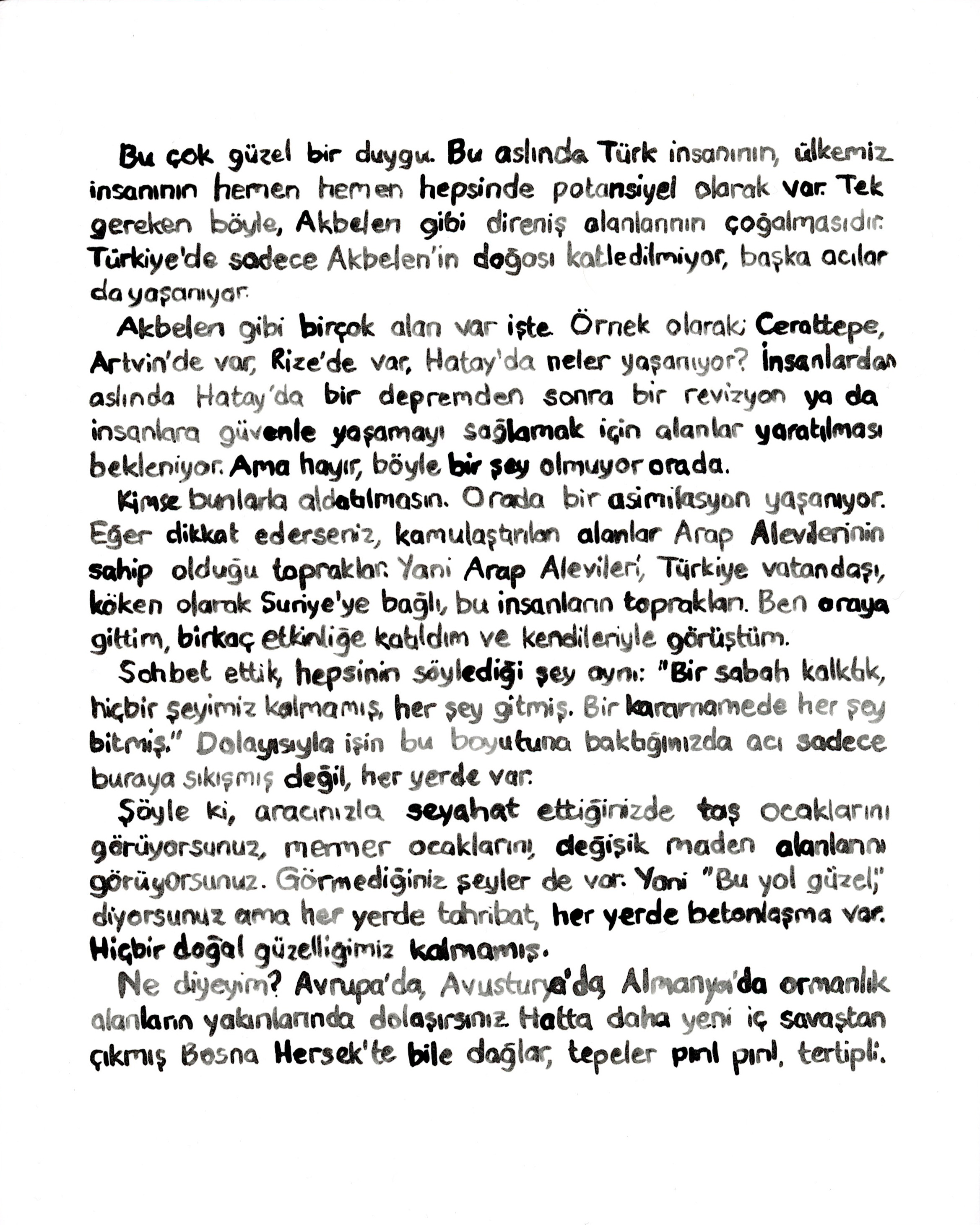
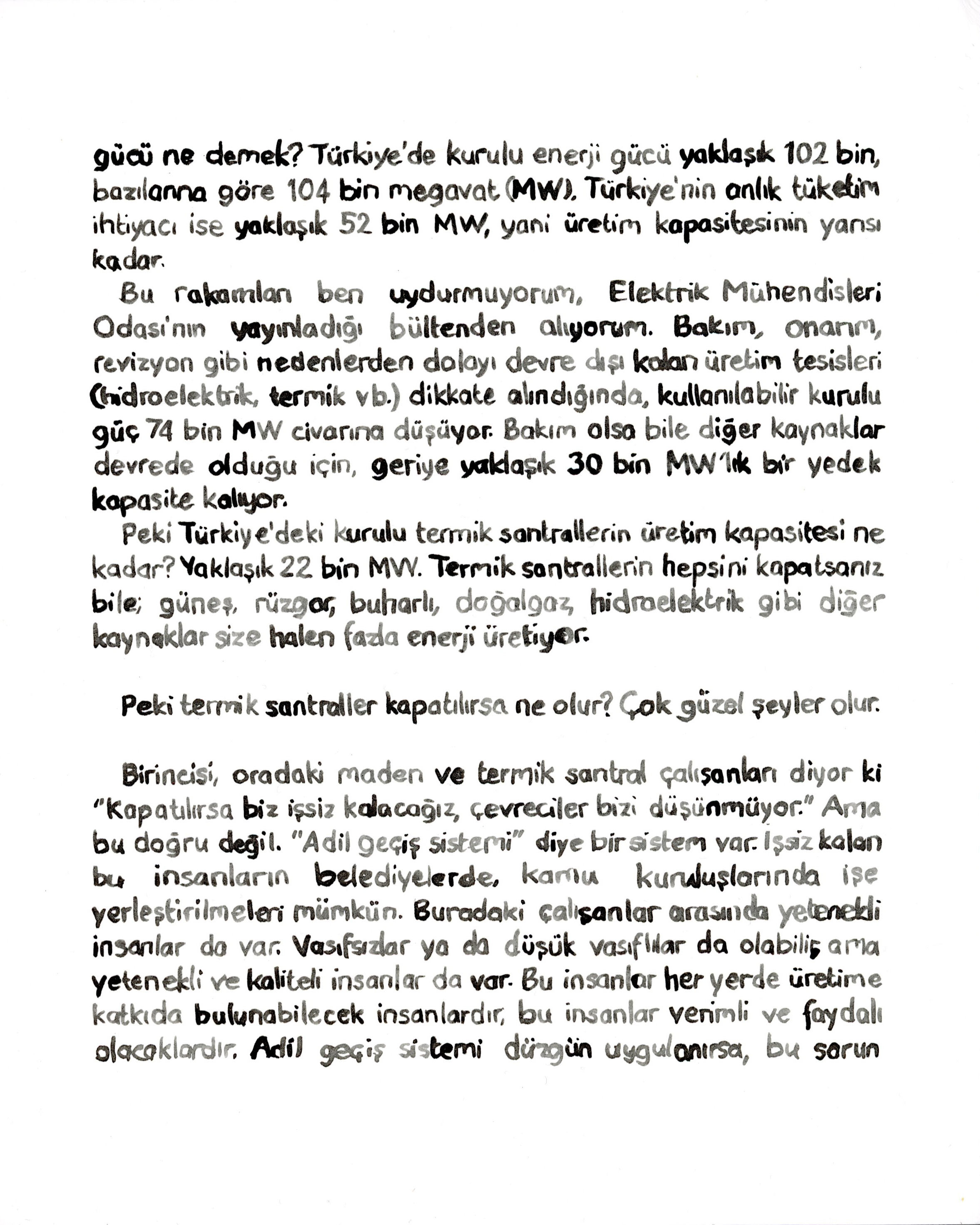
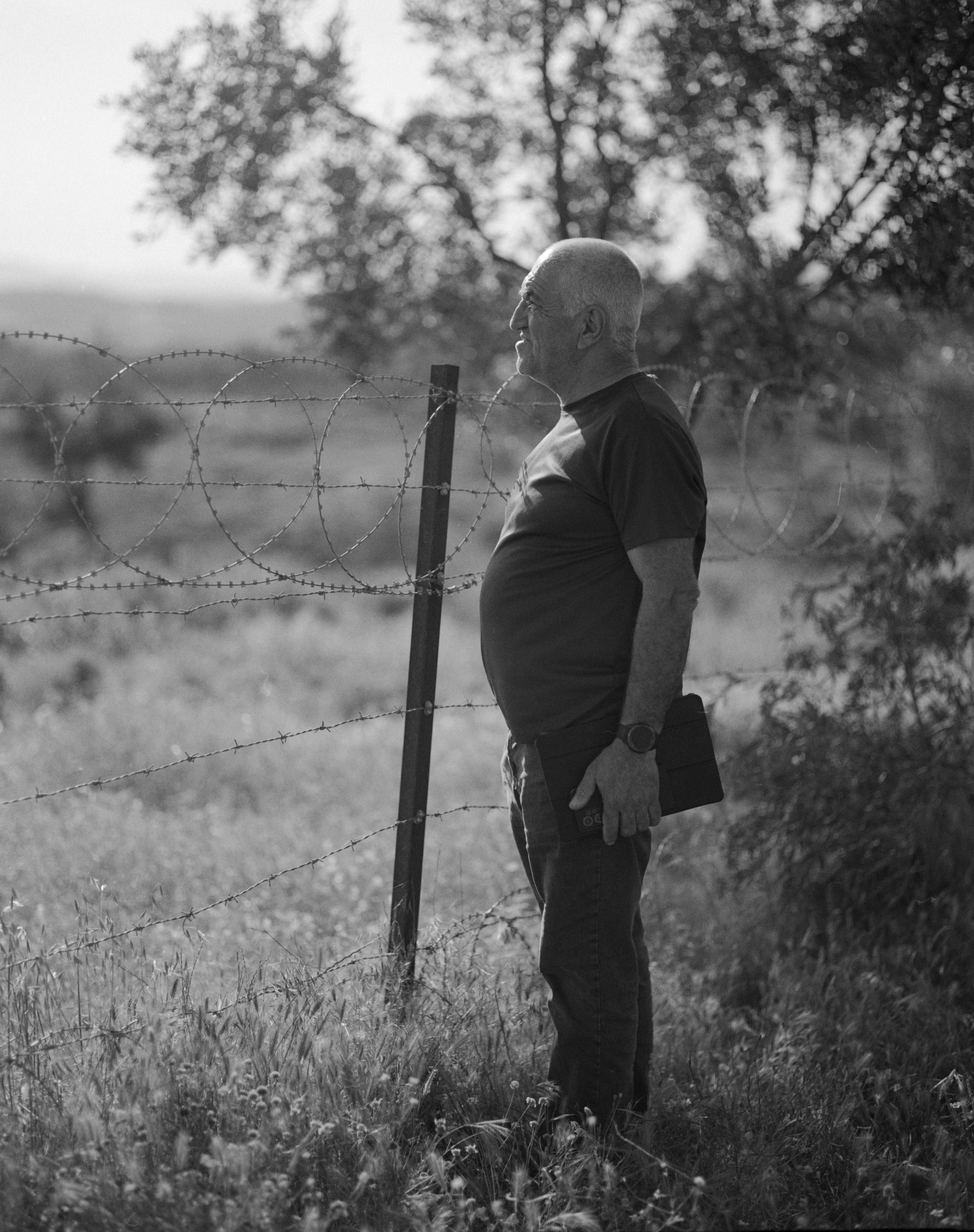
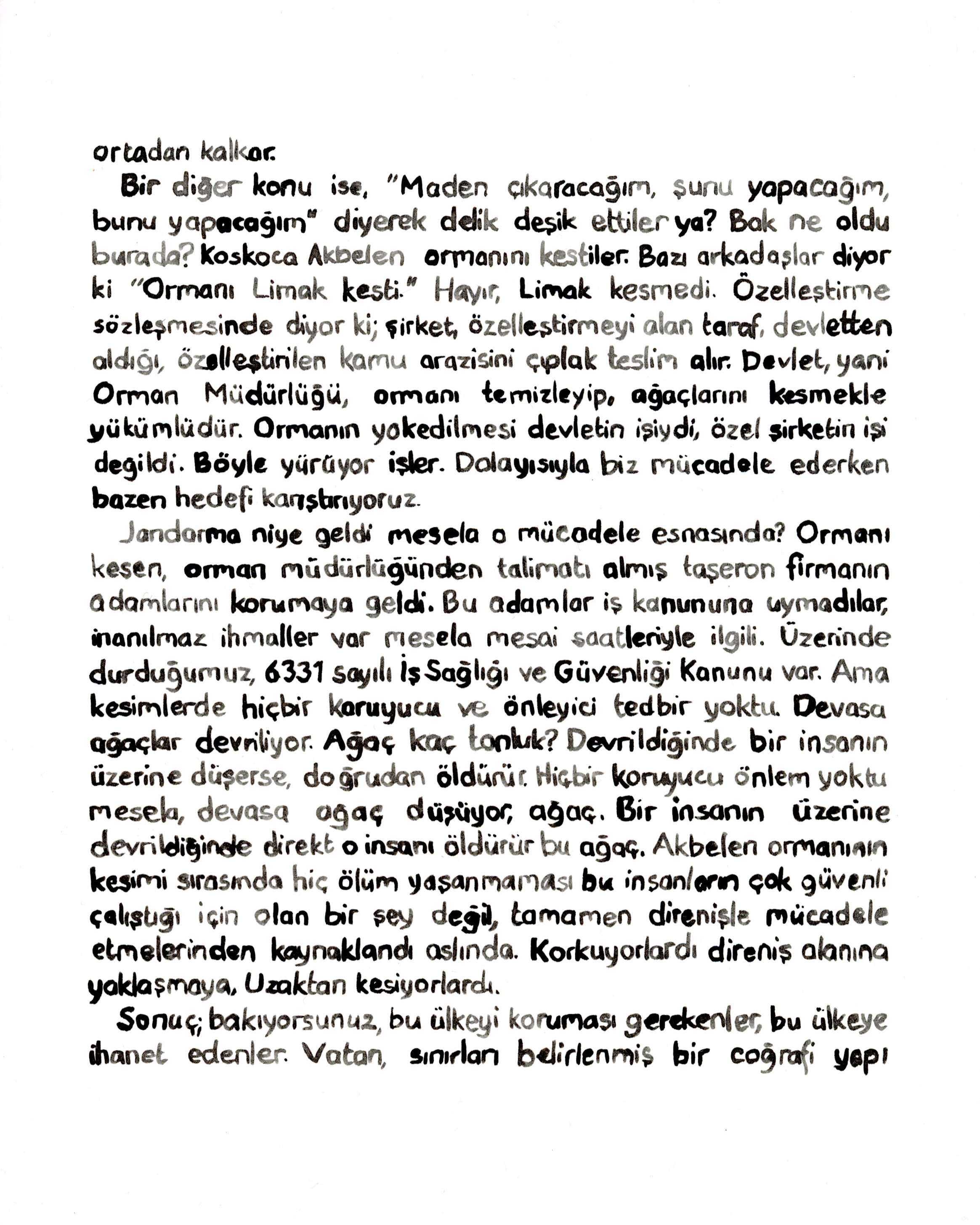
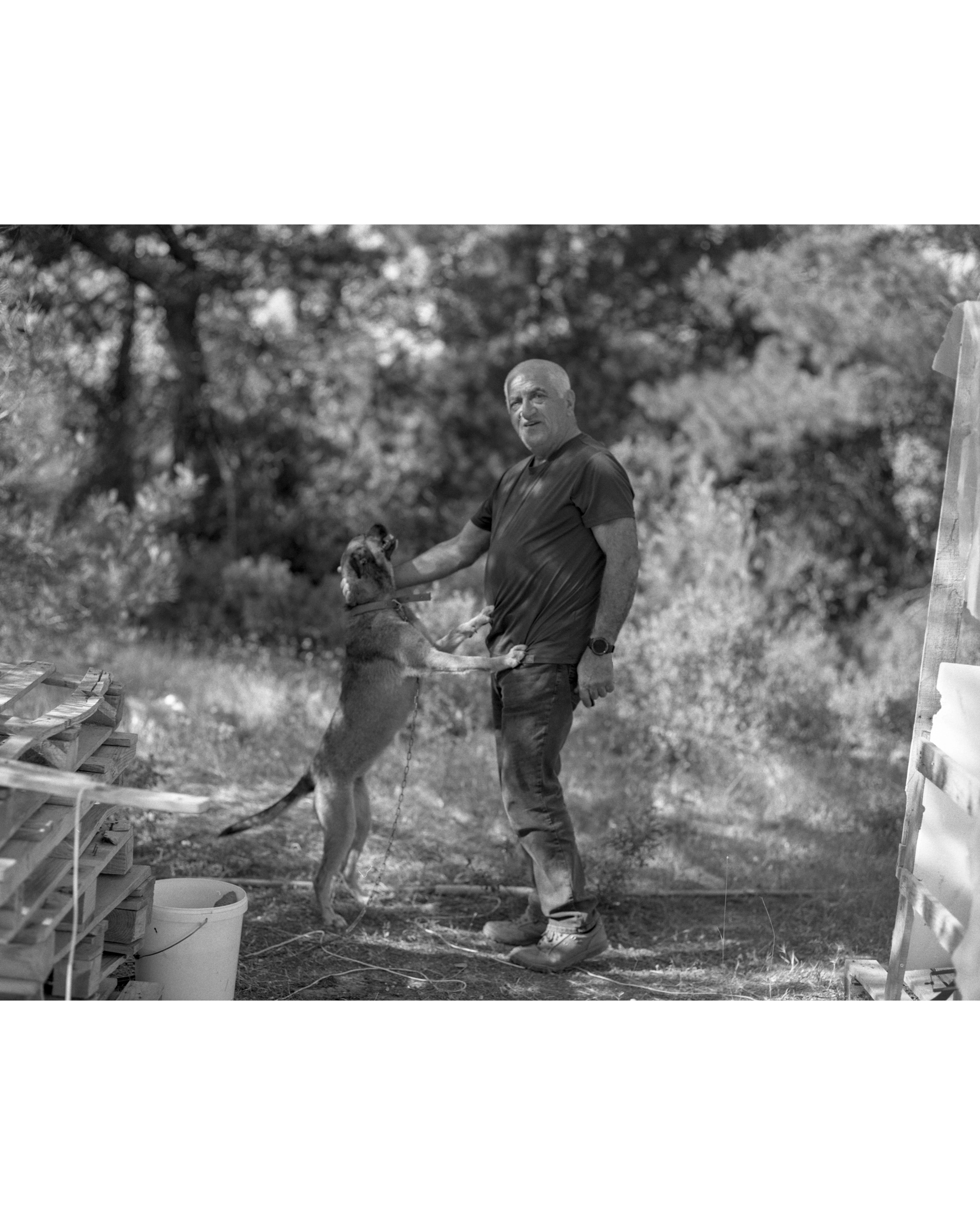
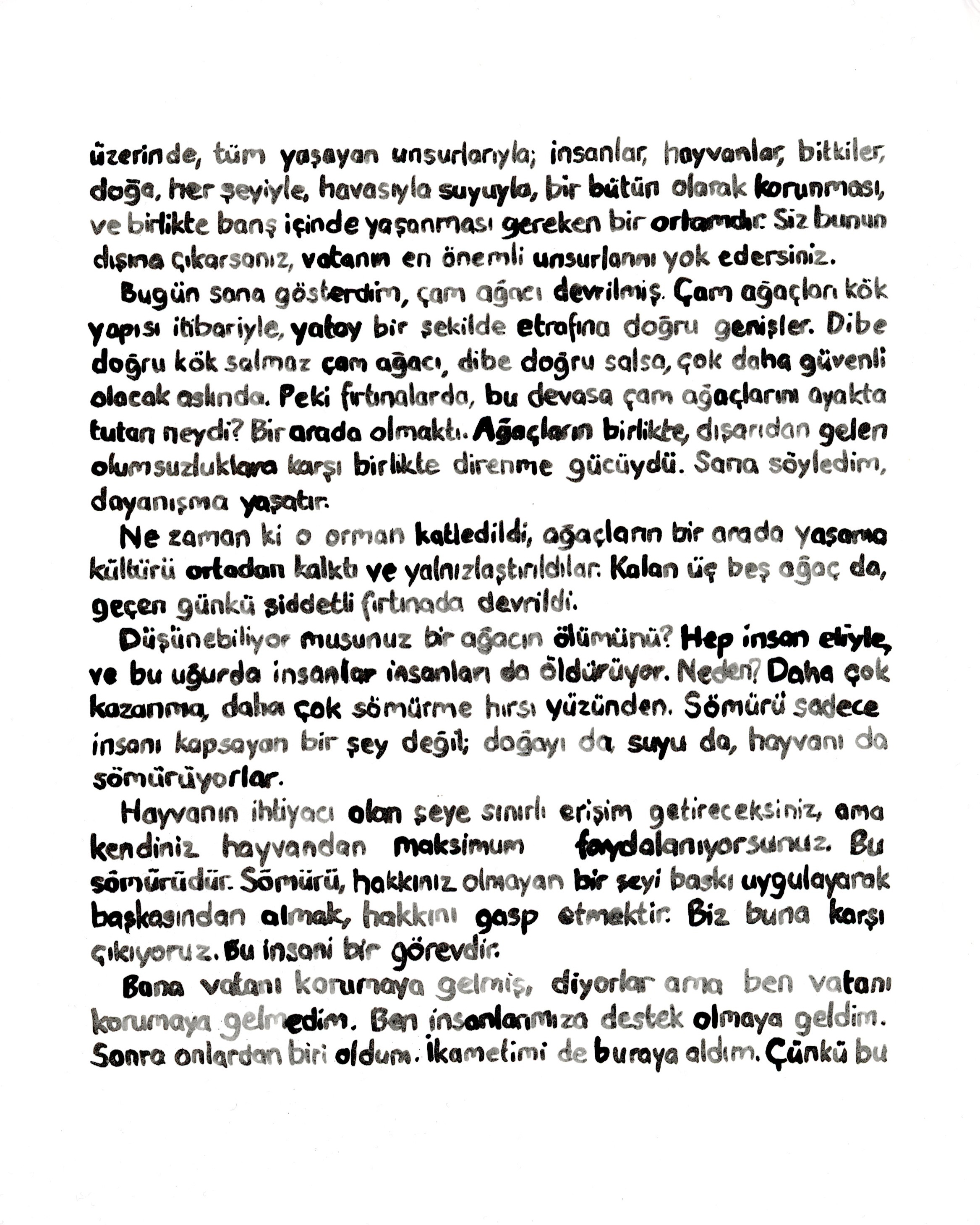
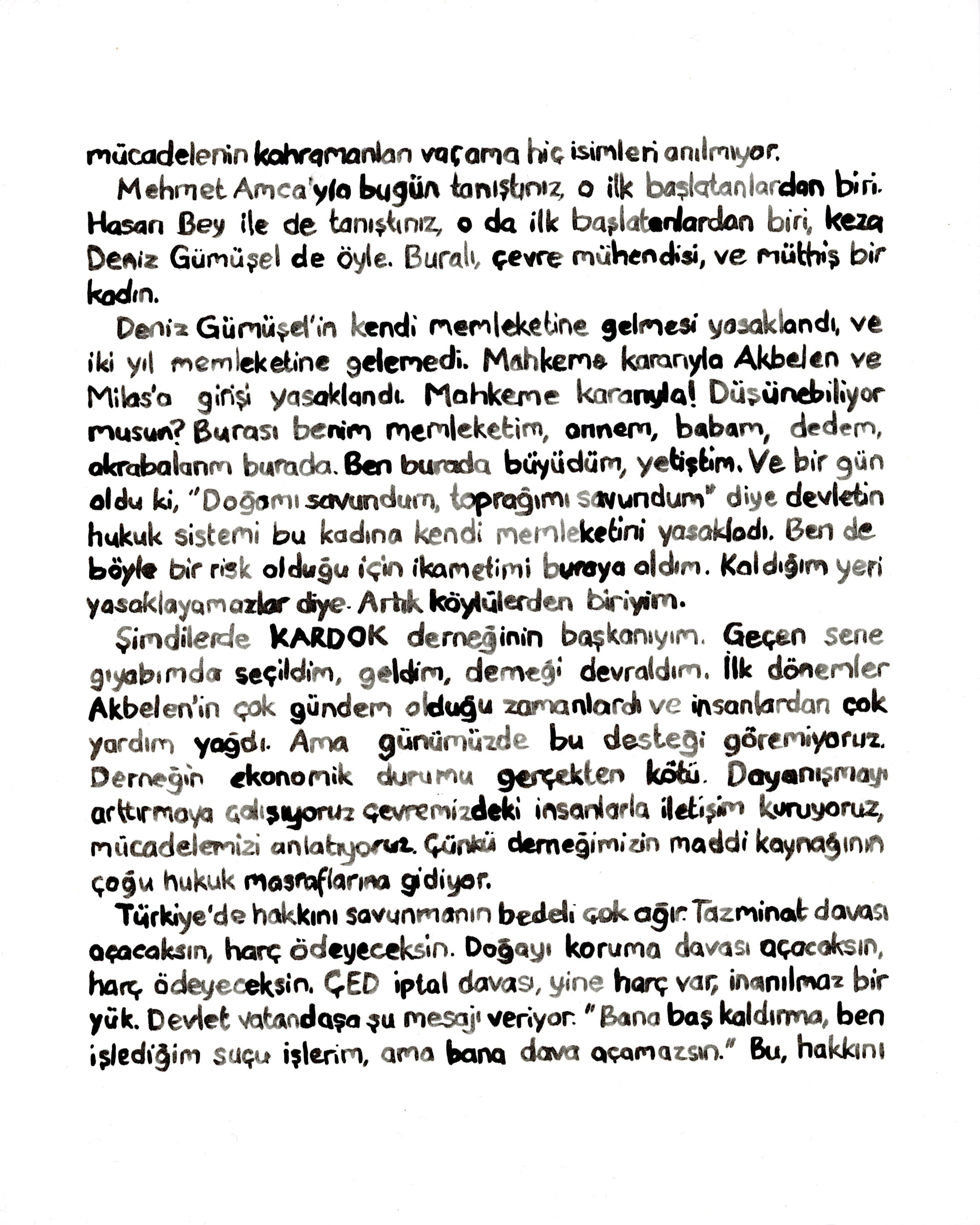
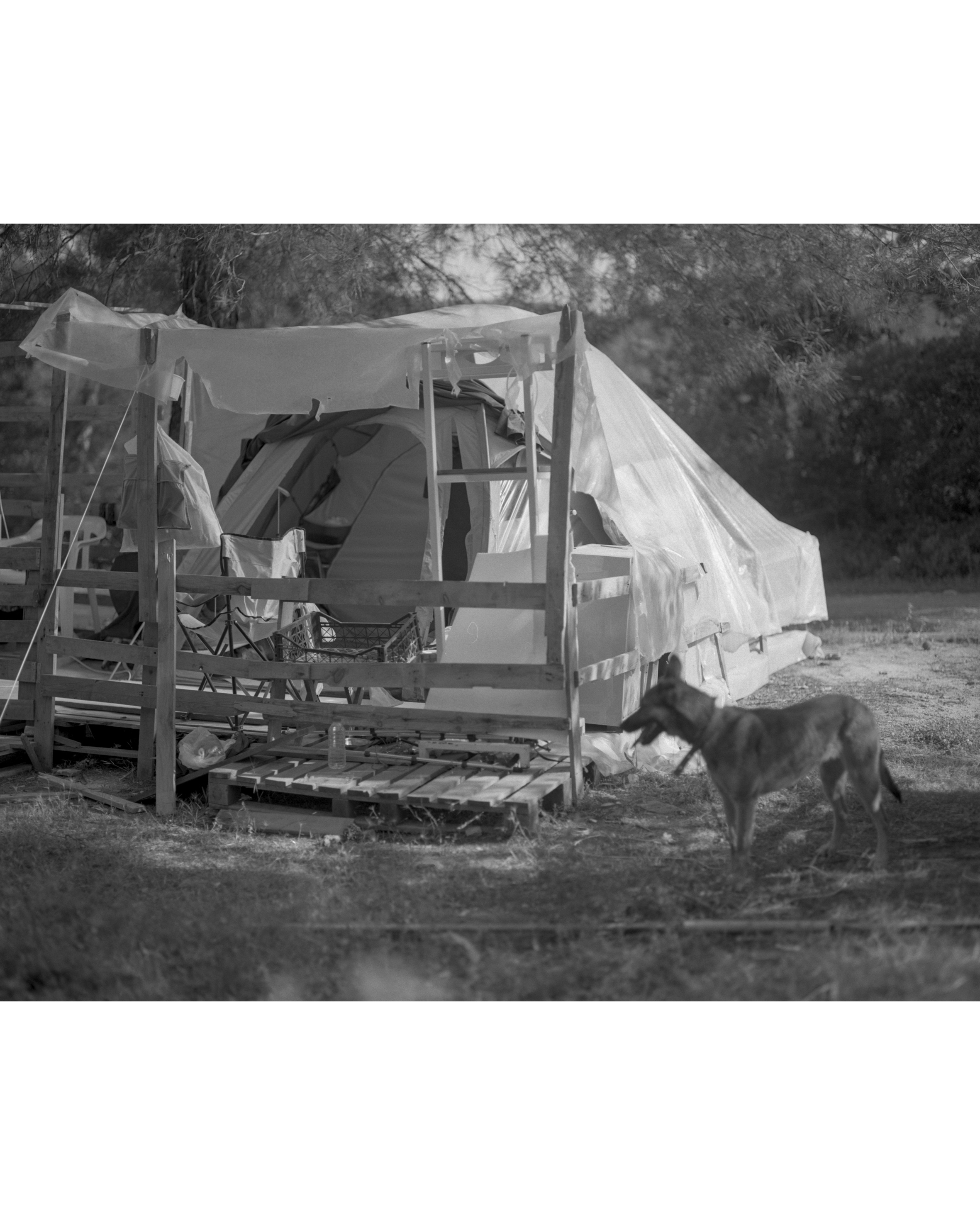
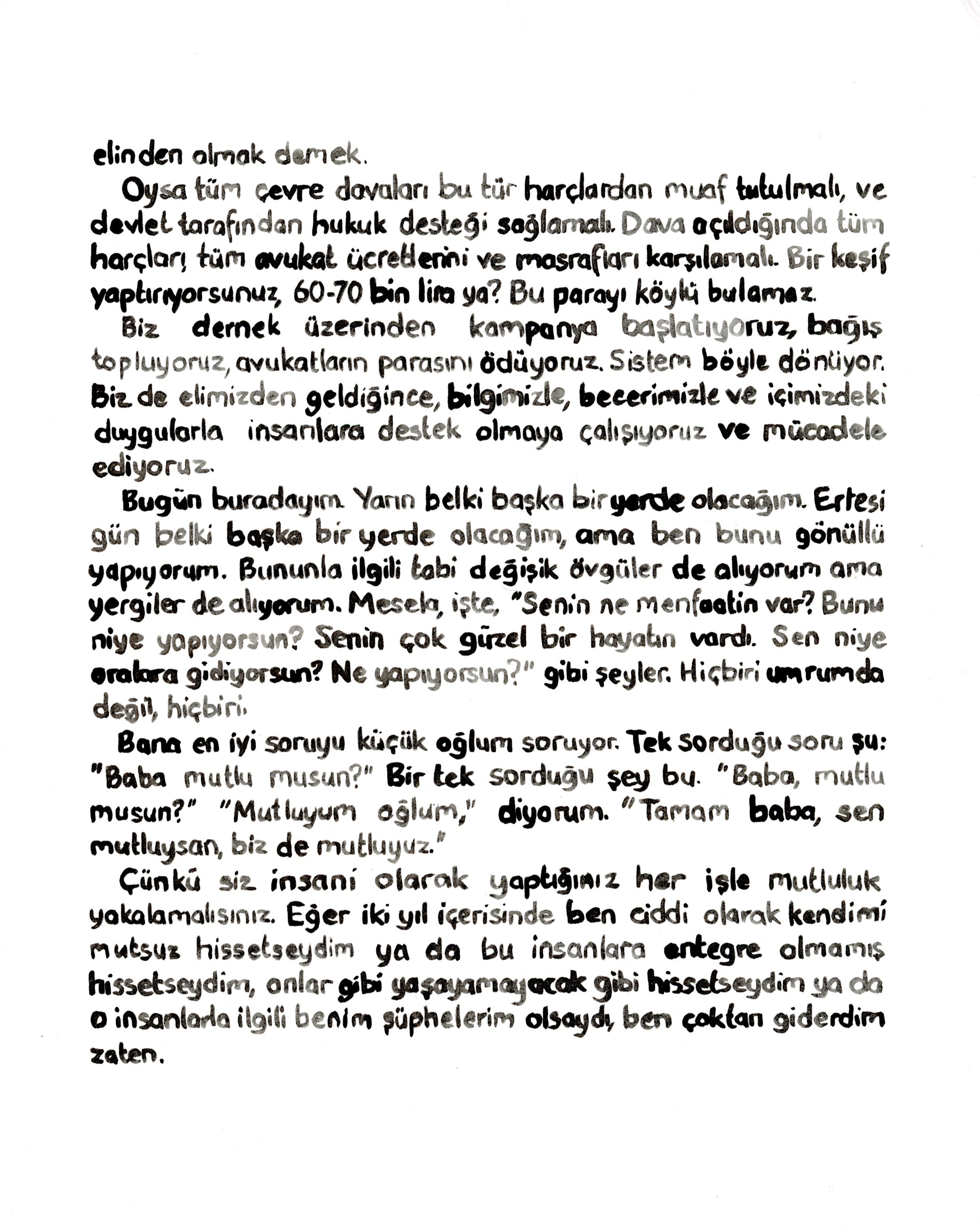
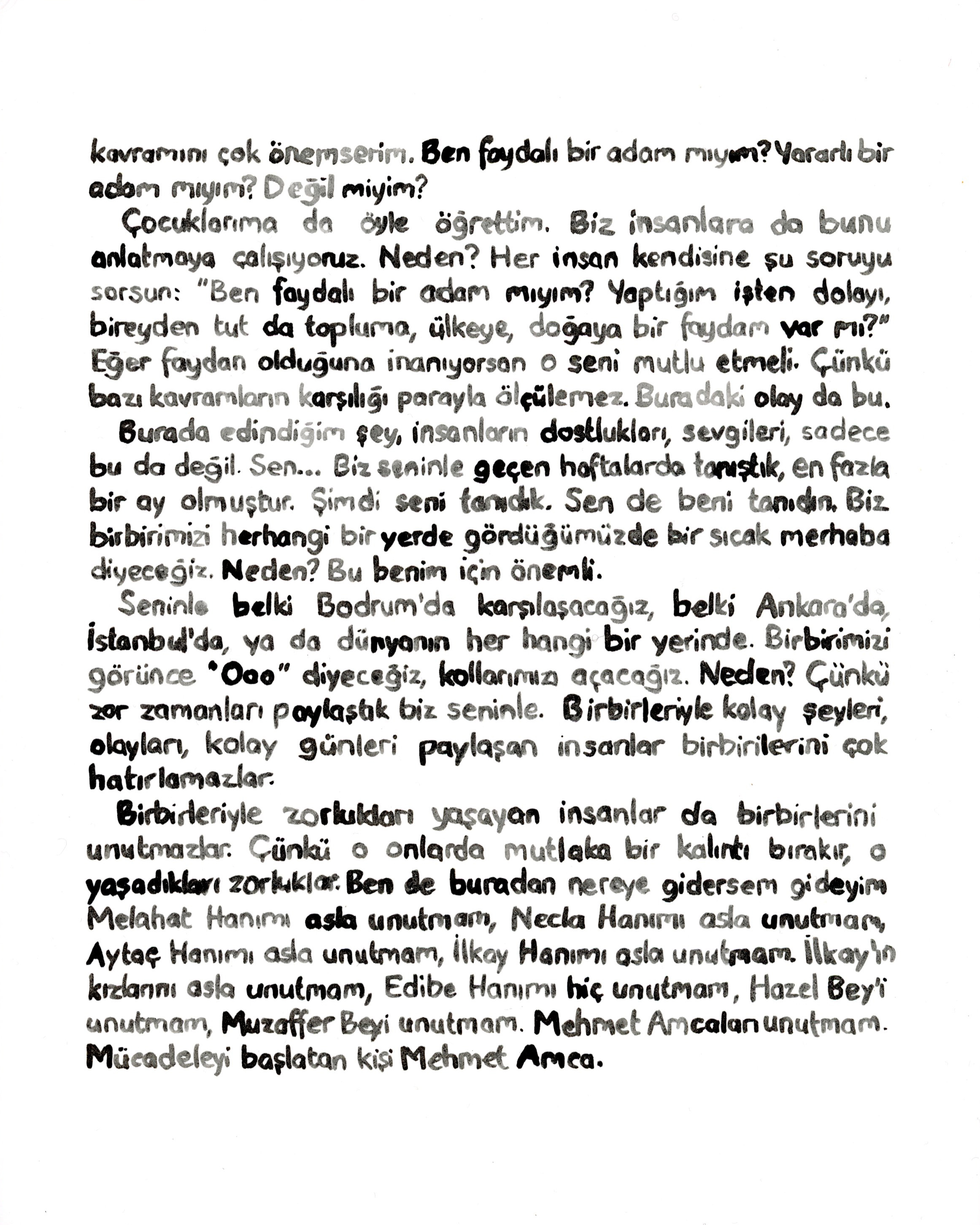

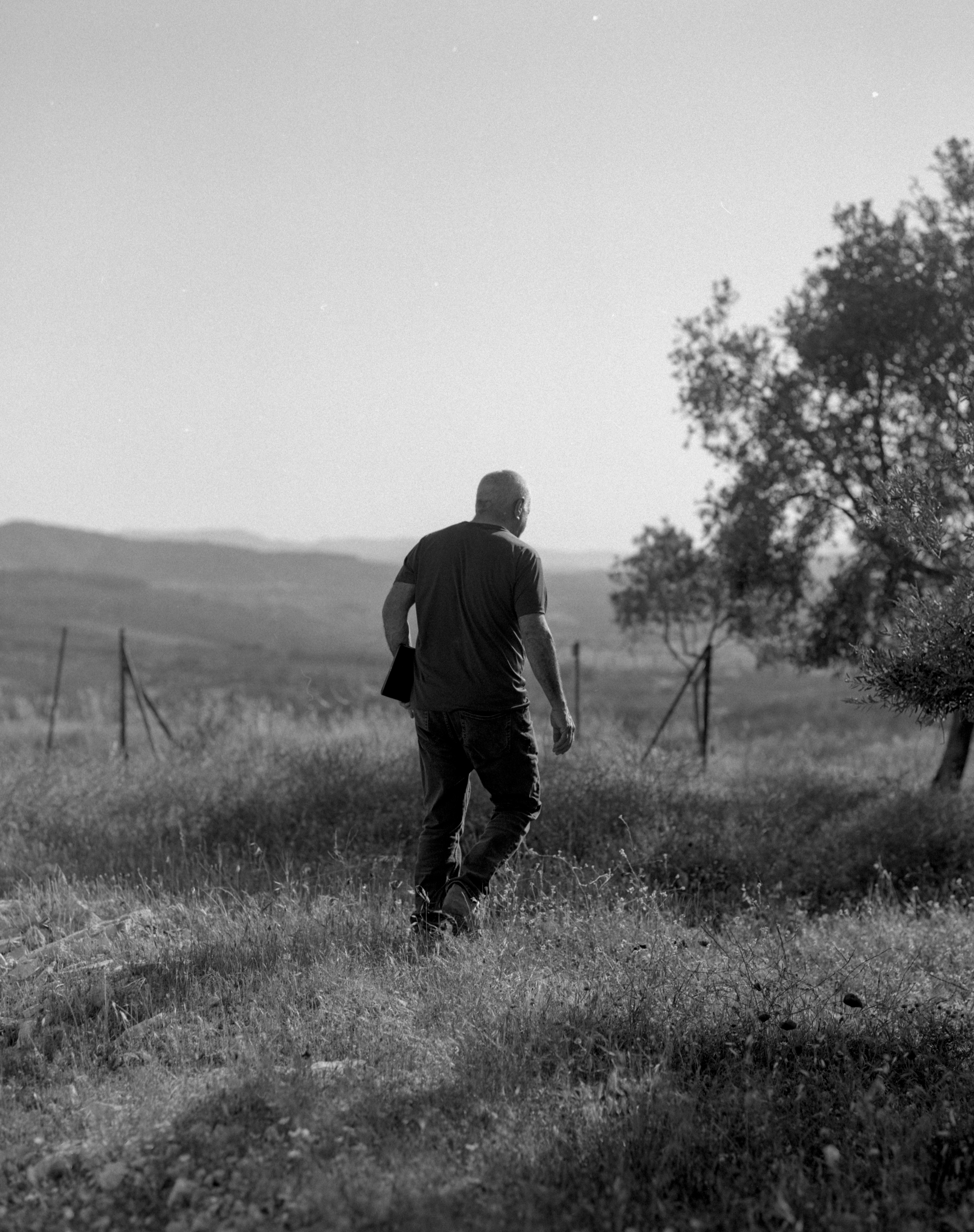
Watercolor of the transcription of our interview with Ahmet, a former energy sector worker turned eco-activist. He first came to Akbelen to show solidarity with the locals and later moved into the village, remaining active in the solidarity movement.
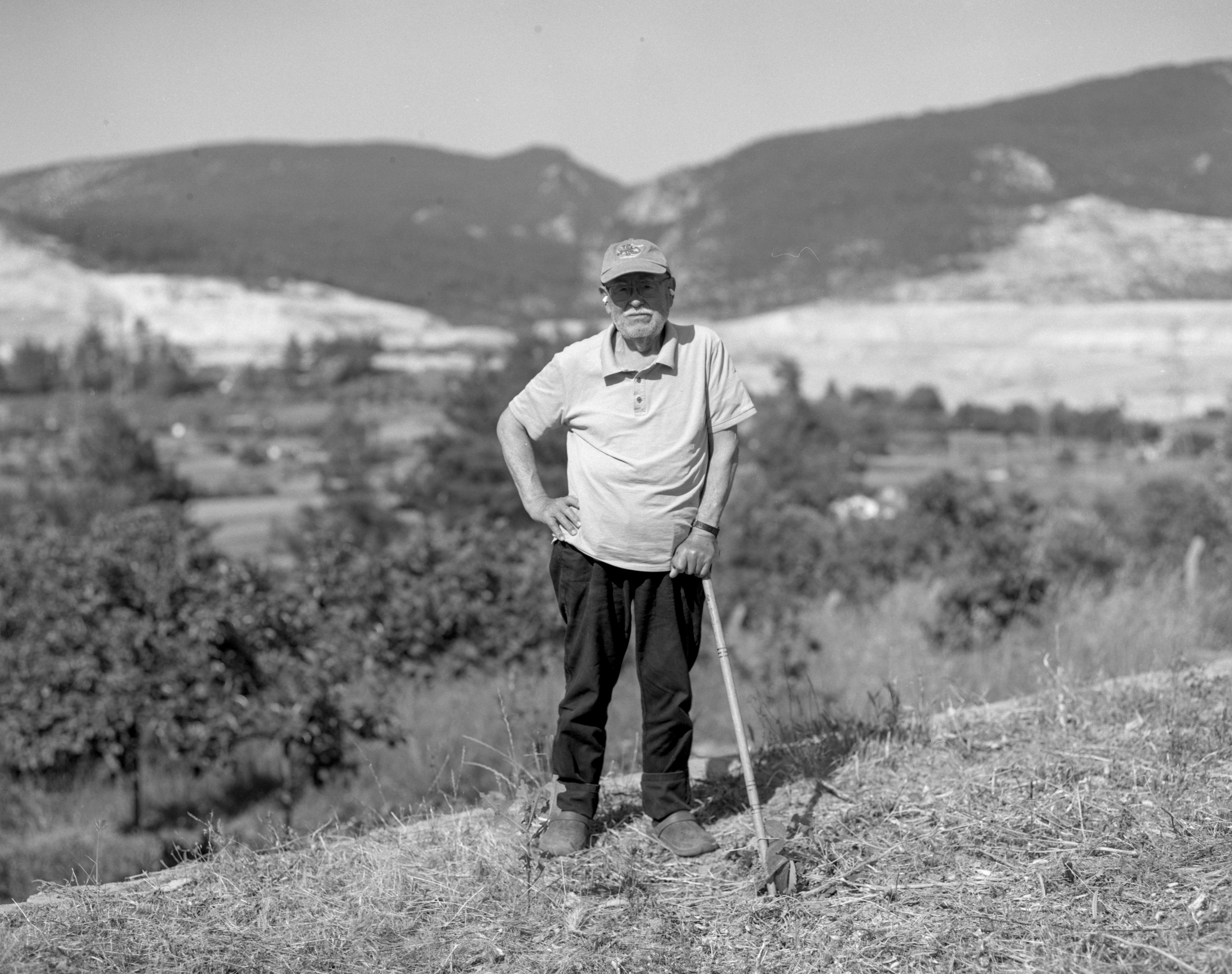
Mehmet, standing in his garden, with the mine that swallowed Akbelen Forest in the background, 2025.

Tree, near Mehmet’s land, with the coal mine in the background, 2025.
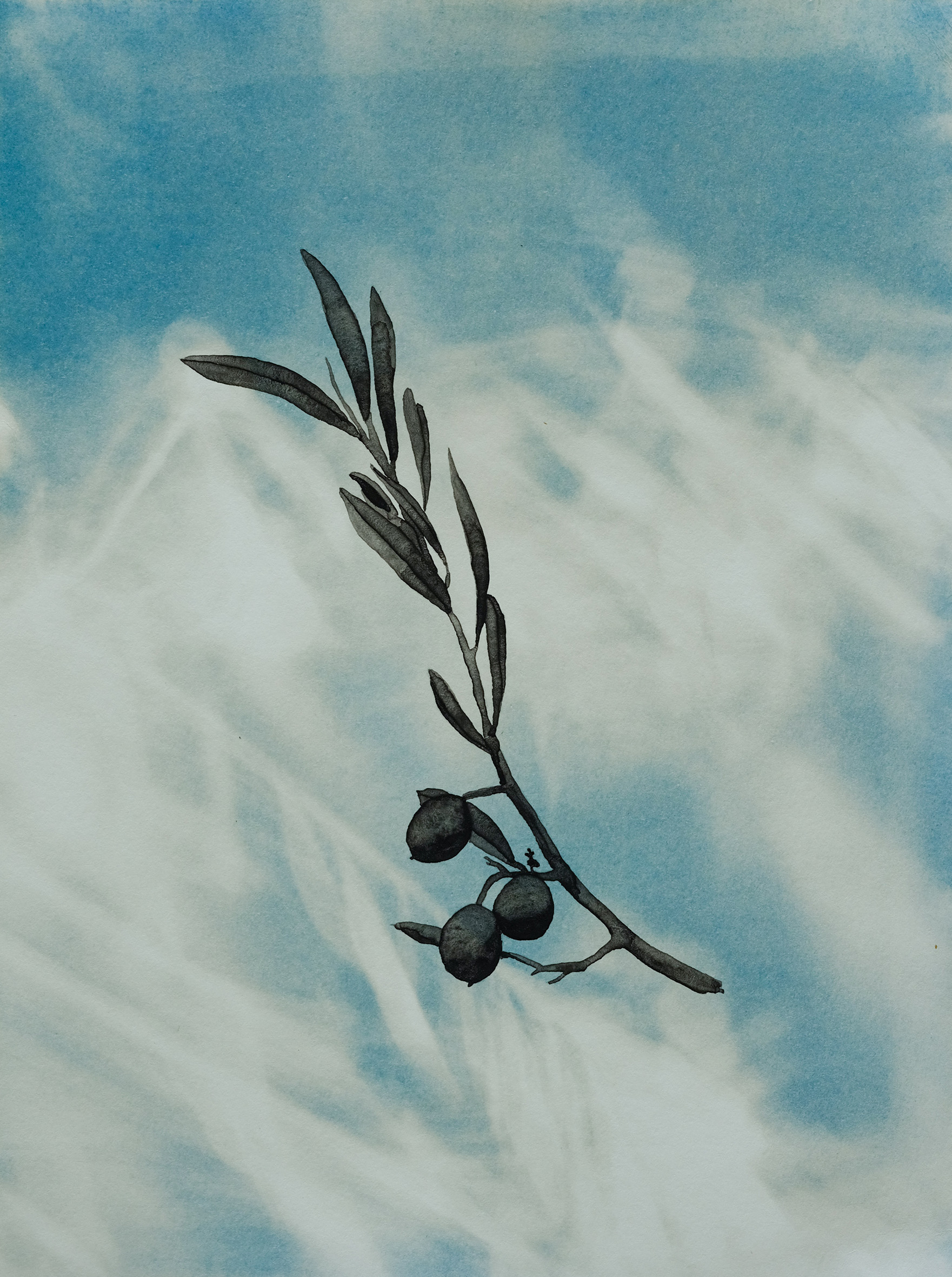
Charcoal and watercolor drawing on a cyanotype print of olive trees in Muğla, 2025.

Tuncer, reading his manifesto in their garden next to the mine, formerly Akbelen Forest, 2024.

Tuncer, waiting for me to drive away safely, 2024.
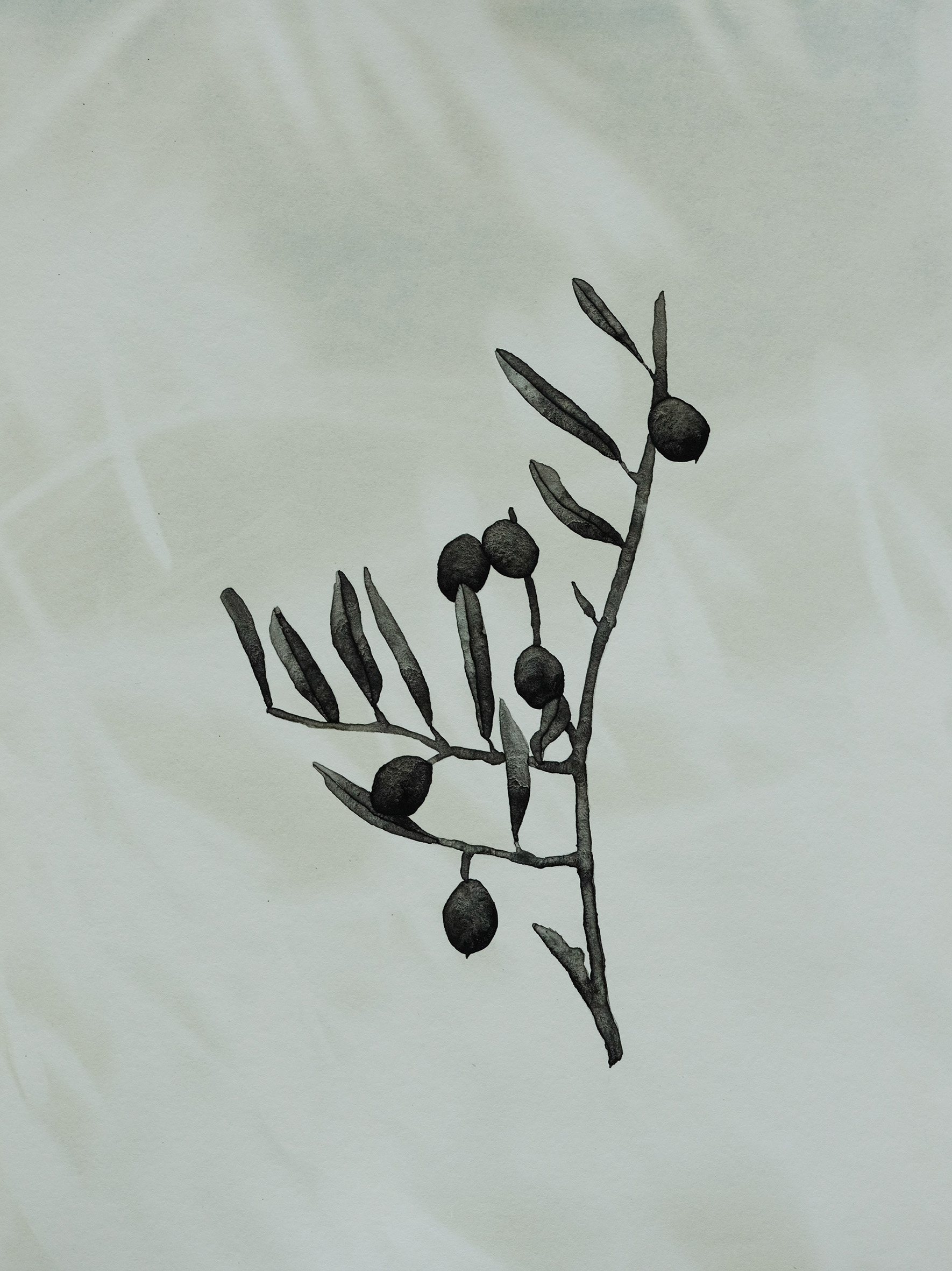
Charcoal and watercolor drawing on a cyanotype print of olive trees in Muğla, 2025.

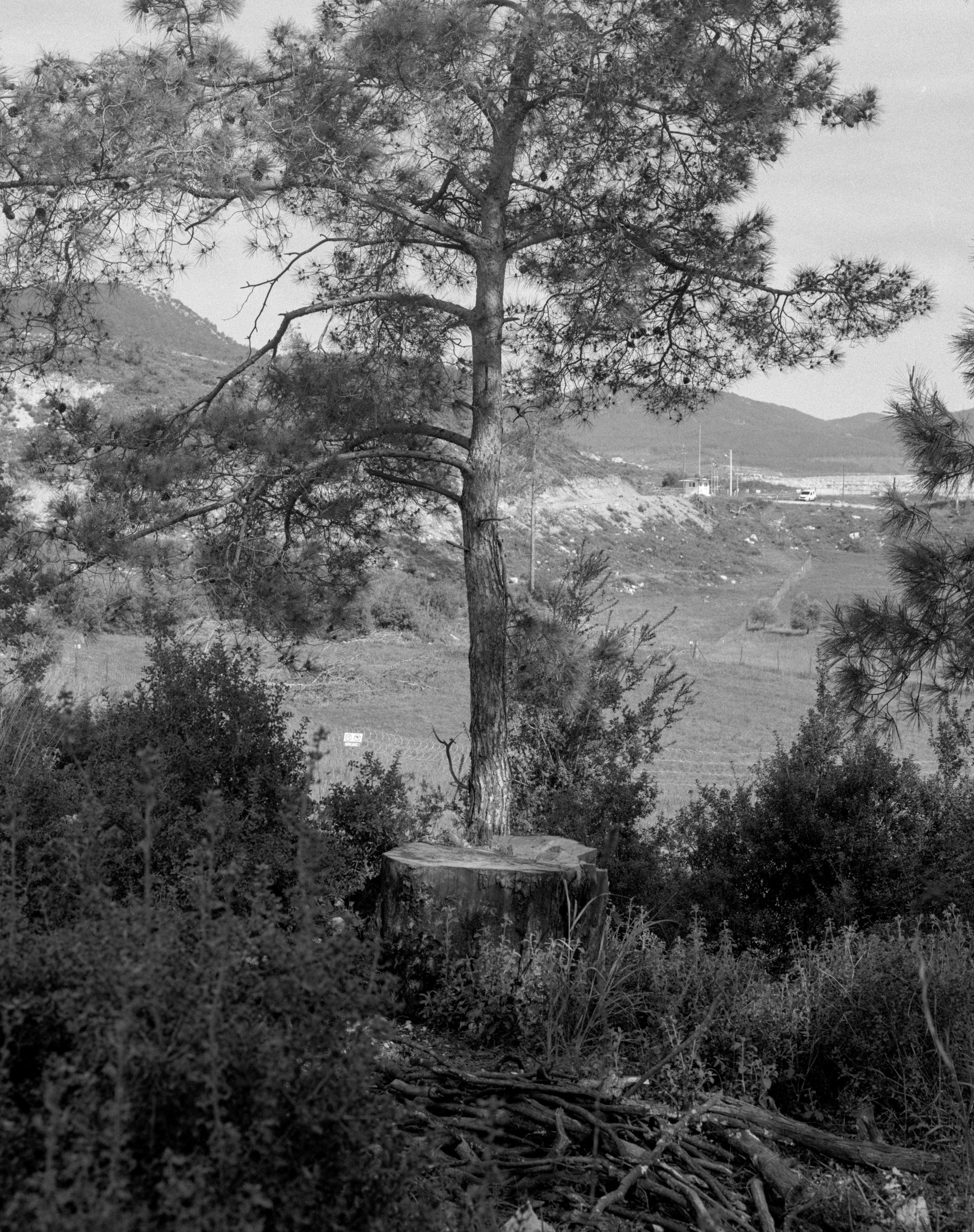
Akbelen Forest’s last trees, right outside coal mine’s barbed wire, 2024.


An untouched area of Akbelen Forest beside the mining site, 2024.
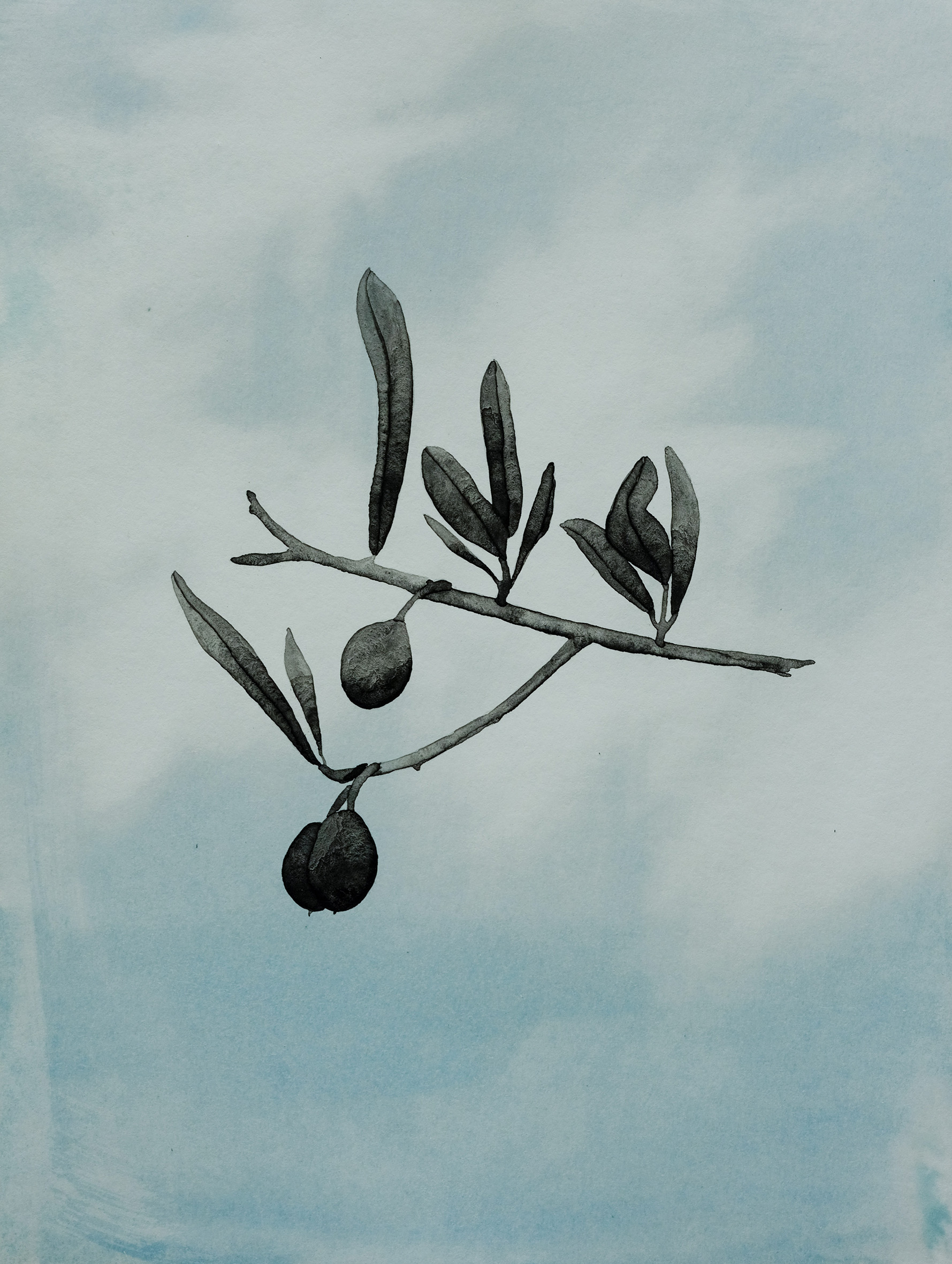
Charcoal and watercolor drawing on a cyanotype print of olive trees in Muğla, 2025.
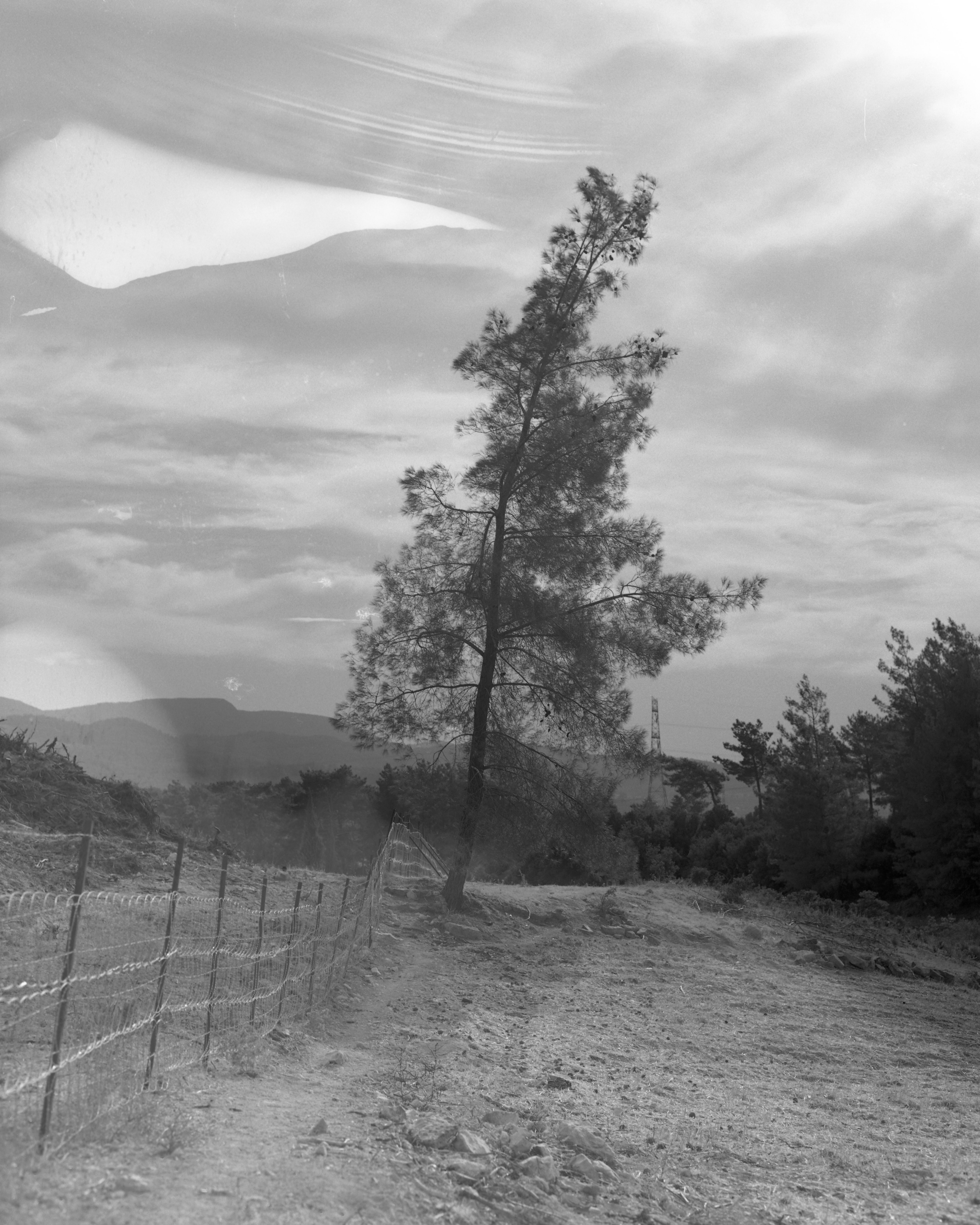
Akbelen Forest’s last trees, right outside the mine’s barbed wire, 2024.

İlkay’s cow, chilling under the tree, 2024.
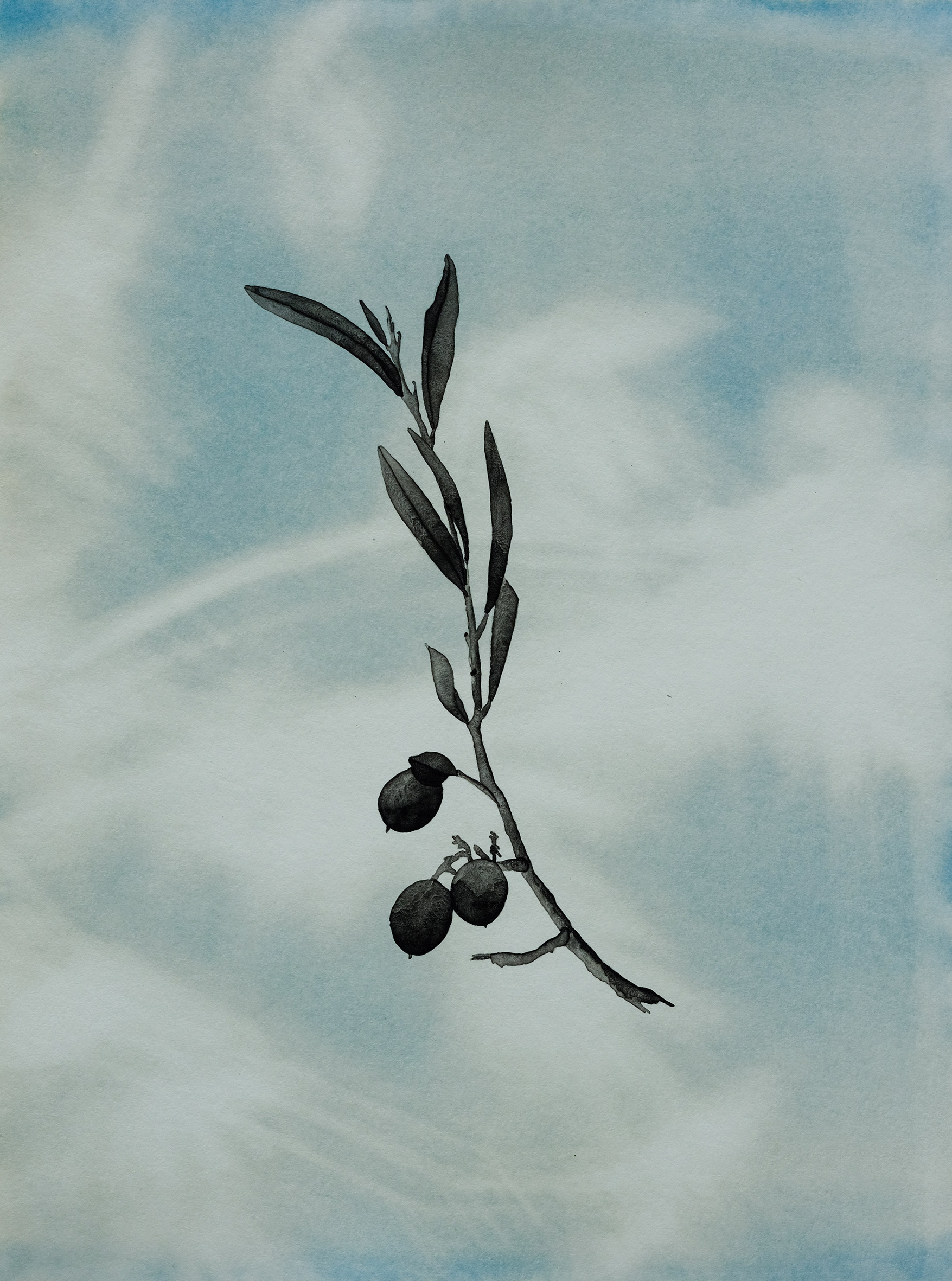
Charcoal and watercolor drawing on a cyanotype print of olive trees in Muğla, 2025.